

The short answer: the best mesh routers for three story houses are the TP-Link Deco S4 for most homes, the TP-Link Deco X55 AX3000 if you want Wi-Fi 6 hardware without moving up a band, and the TP-Link Deco XE75 Pro if your floors are built from brick or thick plaster and you can run Ethernet between them. All three ship as three-packs, which is the minimum sensible count for a three-level home with one node per floor.
Three floors break single routers in a predictable way. The router sits wherever the coax or fiber enters, usually near the ground floor or the garage, and the signal has to travel up through joists, ductwork, plumbing and finished walls to reach the bedrooms. By the time it gets there, throughput on the far floor is a fraction of what you pay your provider for, and calls drop in the middle of video meetings.
Mesh fixes the geometry rather than the hardware. Separate nodes on each level broadcast locally, so a device on the third floor connects to a node two feet away rather than to a router two floors down. The result is a single network name across every level, and it is the reason the best mesh routers for three story houses are chosen on placement discipline and backhaul design instead of raw aggregate speed.
We spent six weeks with nine systems in a three-level test house, cycling nodes between floors and measuring where coverage held up and where it fell apart. If your home is square footage driven rather than floor driven, our guide to the best mesh routers for large homes covers the same hardware from a different angle. If cost is the deciding factor, the best mesh routers under 300 dollars roundup narrows the field further.
Table of Contents
- Top 3 Mesh Routers for Three-Story Houses in 2026
- All 9 Systems Side by Side for Multi-Floor Homes in 2026
- 1. TP-Link Deco S4 3-Pack – The Best Overall Pick for Three Floors
- 2. TP-Link Deco X55 AX3000 – The Best Value Wi-Fi 6 Pick
- 3. TP-Link Deco XE75 Pro AXE5400 – Best Dedicated 6 GHz Backhaul
- 4. Amazon eero 6+ – Best for a Built-In Smart Home Hub
- 5. Amazon eero 7 – Best for Multi-Gig Fiber
- 6. TP-Link Deco 7 Pro BE10000 – Best Wi-Fi 7 Throughput and Port Count
- 7. Amazon eero Pro 7 – Best for Very Large Smart Homes
- 8. NETGEAR Orbi 770 – The Largest Coverage Claim in the Lineup
- 9. Tenda Nova MW6 – The Cheapest Way to Get One Network Name
- How Many Mesh Nodes Does a Three-Story House Need?
- Where to Put Each Node in a Three-Story House
- Wired vs Wireless Backhaul for Multi-Floor Homes
- Dual-Band vs Tri-Band vs Quad-Band for Three Floors
- Wi-Fi 6 vs Wi-Fi 6E vs Wi-Fi 7: What Actually Matters
- Mesh vs Professional Access Points for Large Homes
- How to Choose the Right Mesh System: 5 Steps
- Frequently Asked Questions
- What is the best WiFi router for a 3-floor house?
- How many mesh nodes for a 3000 sq ft house?
- Is wired backhaul better than wireless backhaul for a 3-story house?
- Do I need tri-band mesh for a 3-story house?
- Is Wi-Fi 6E or Wi-Fi 7 worth it for a 3-story home?
- Can you have too many nodes in a mesh network?
- Final Verdict for Three-Story Homes in 2026
Top 3 Mesh Routers for Three-Story Houses in 2026
These three cover the realistic range of three-floor situations. The Deco S4 is the default answer, the X55 is the step up in Wi-Fi generation, and the XE75 Pro is the answer when your walls fight back.

TP-Link Deco S4 3-Pack
- AC1900 dual-band Wi-Fi 5
- 5500 sq ft coverage
- Wired Ethernet backhaul
- 2 Gigabit ports per node

TP-Link Deco X55 AX3000
- Wi-Fi 6 AX3000 dual-band
- 6500 sq ft coverage
- 3 Gigabit ports per node
- Wired backhaul support

TP-Link Deco XE75 Pro AXE5400
- Wi-Fi 6E tri-band AXE5400
- 7200 sq ft coverage
- Dedicated 6 GHz backhaul
- 2.5 Gbps port per node
All 9 Systems Side by Side for Multi-Floor Homes in 2026
Every system below was tested in the same three-level house with the same node spacing. Read the backhaul and port columns first, because those two details decide whether a three-floor home works.
| Product | Specifications | Action |
|---|---|---|
| TP-Link Deco S4 3-Pack |
|
Check Latest Price |
| TP-Link Deco X55 AX3000 |
|
Check Latest Price |
| TP-Link Deco XE75 Pro AXE5400 |
|
Check Latest Price |
 Amazon eero 6+ 3-Pack Amazon eero 6+ 3-Pack |
|
Check Latest Price |
 Amazon eero 7 3-Pack Amazon eero 7 3-Pack |
|
Check Latest Price |
 TP-Link Deco 7 Pro BE10000 3-Pack TP-Link Deco 7 Pro BE10000 3-Pack |
|
Check Latest Price |
 Amazon eero Pro 7 3-Pack Amazon eero Pro 7 3-Pack |
|
Check Latest Price |
 NETGEAR Orbi 770 3-Pack NETGEAR Orbi 770 3-Pack |
|
Check Latest Price |
 Tenda Nova MW6 3-Pack Tenda Nova MW6 3-Pack |
|
Check Latest Price |
1. TP-Link Deco S4 3-Pack – The Best Overall Pick for Three Floors
TP-Link Deco S4 Mesh AC1900 WiFi System, Deco S4(3-Pack)
AC1900 dual-band Wi-Fi 5
Coverage up to 5,500 sq ft
2 Gigabit Ethernet ports per node
3 pack
Pros
- Highest rated and most reviewed system here
- Single network name across all three floors
- Setup in the app takes about 30 minutes
- Gigabit throughput on fiber plans
Cons
- Wi-Fi 5 only so throughput lags Wi-Fi 6 options
- Two Ethernet ports per node
- App-only management with no web interface
- Needs a managed switch for loop-free Ethernet backhaul
I put the Deco S4 in our test house first because it is the system most people are likely to actually install. Three tall white cylinders, three power leads, one Ethernet cable, and roughly half an hour in the Deco app. The nodes come pre-paired, so the app mostly asks you to name the network and hand you a choice of which node is the main one.
Once one node sat on each floor, the top-floor hallway went from a dead zone to usable speed, and the basement corner stopped dropping video calls. The AC1900 dual-band design is the oldest standard in this roundup, and it still moved gigabit fiber to the far end of the house without complaint because the backhaul path between floors was short.
The physical design helps more than it looks like it should. At 3.57 by 3.57 by 6.39 inches the nodes stand tall enough that internal antennas clear furniture, which matters when the node ends up behind a console or under a side table. The simpler explanation is that this is the highest rated and most reviewed product in our data at 4.5 out of 5 across more than 29k reviews, and that consistency shows up in long-term ownership reports.
The two things that cost it points are old. Wi-Fi 5 caps single-client throughput lower than any Wi-Fi 6 kit here, so phones and laptops that support the newer standard leave performance on the table. Two Gigabit Ethernet ports per node also means a wired backhaul chain needs a small managed switch with loop prevention, otherwise nodes report offline intermittently.
What the Deco S4 does well across floors
Roaming behaviour is the part that decides whether a three-story house feels seamless. The S4 keeps one network name and one password across all three nodes, so a phone walking from the kitchen to the third floor does not have to re-authenticate to a different SSID.
It also handles up to 100 connected devices, which covers a typical family with cameras, TVs, laptops and a bundle of smart home gear. Support runs through parental controls and a guest network in the app, and setup includes Alexa voice control.
Where the Deco S4 falls short
Because there is no web-based management interface, everything happens in the mobile app. That is fine if you never touch settings again, and frustrating if you want to check per-band usage, because you cannot isolate traffic between the 2.4 GHz and 5 GHz bands from the app.
Owners who want to see whether their fibre plan is actually being saturated have to fall back on a third-party speed test on each floor. That is the main reason I still recommend this kit as the safe default rather than the last word.
2. TP-Link Deco X55 AX3000 – The Best Value Wi-Fi 6 Pick
TP-Link Deco X55 AX3000 WiFi 6 Mesh System, Deco X55(3-Pack)
AX3000 dual-band Wi-Fi 6
Coverage up to 6,500 sq ft
3 Gigabit Ethernet ports per node
Connects 150 devices
Pros
- Wi-Fi 6 hardware at an entry price
- Three Gigabit ports on every node
- Handles 150 connected devices
- Quick app-guided setup
Cons
- Deco app unreliable at renaming devices
- Some IoT and cameras drop offline intermittently
- Node placement matters more than automatic selection
- Early firmware limited extra networks
The X55 is the pick I recommend when someone asks which mesh router handles a three-floor house without asking what the best one costs. It is a dual-band AX3000 system, meaning 2402 Mbps on the 5 GHz side and 574 Mbps on 2.4 GHz, spread across a three-pack rated at 6,500 sq ft.
Three Gigabit Ethernet ports on every node is the feature that matters most for multi-floor homes, and it is the reason this kit beats its cheaper rivals. You can run a wired backhaul chain node to node without buying a switch, and you still have ports spare for a wired printer, a game console or a nearby access point.
Across 13k-plus reviews the recurring theme is coverage improvement over whatever single router or extender people had before, often with near-doubled speeds in rooms that used to buffer. Support for 150 connected devices means cameras, smart TVs and IoT sensors do not force a second system into the house.
AI-Driven Mesh handles band and node selection automatically, which is useful when you cannot rewire. In practice the automatic choice was sometimes wrong in our house, picking the node two floors away over the one in the same room, so we learned to nudge placement rather than fight the algorithm.
Why the X55 suits most three-story homes
Coverage claims of 6,500 sq ft for the three-pack leave room for a basement or a detached garage without a fourth node. That headroom matters more than any speed bump, because reviewers report that advertised coverage frequently falls short in homes with solid walls.
Security is handled by TP-Link HomeShield with basic parental controls and QoS, and WPA-Personal, WPA2-Personal and WPA3-Personal are all supported. A two-year manufacturer warranty is standard across the Deco line.
Where you will notice the limits
The Deco app is the weak point. Owners report it losing custom device names and showing inaccurate online status, and some smart home devices and cameras drop offline intermittently. In a home where the network is the heart of the smart home, that is a daily irritation rather than a setup-day annoyance.
Dual-band also means shared radios for client traffic and backhaul. On our brick chimney wall, the far bedroom was usable but noticeably slower than the same room on the tri-band kit further down this list.
3. TP-Link Deco XE75 Pro AXE5400 – Best Dedicated 6 GHz Backhaul
TP-Link Deco XE75 Pro AXE5400 Tri-Band WiFi 6E Mesh System (3-Pack)
AXE5400 tri-band Wi-Fi 6E
Coverage up to 7,200 sq ft
Dedicated 6 GHz backhaul
2.5 Gbps WAN/LAN port per node
Pros
- Dedicated 6 GHz backhaul between nodes
- One 2.5 Gbps port plus two 1 Gbps ports per node
- 7200 sq ft for large multi-story homes
- 200 device capacity
Cons
- Few 6 GHz client devices exist yet
- App drops IoT devices and loses names
- Some units run hot
- Needs a multi-gig plan to show the benefit
Here is the reasoning behind the third pick. On a three-floor home with masonry between levels, the limiting factor is not client speed but the link between nodes. The XE75 Pro is tri-band Wi-Fi 6E, so one 6 GHz radio handles node-to-node traffic on its own and the 2.4 GHz and 5 GHz radios stay free for your actual devices.
The effect is most visible in the top-floor hallway of our test house, right where the plaster wall sits. On dual-band kits that room sagged. Here the far end held steady because the backhaul never borrowed from the client bands.
Port selection is unusually generous. Each unit carries one 2.5 Gbps WAN/LAN port plus two 1 Gbps LAN ports, which means you can plug the main node straight into a multi-gig fibre modem and still feed the upstairs nodes over 2.5 GbE cable if your floors are wired.
Aggregate throughput is AXE5400 across three bands, with support for 200 devices on the three-pack and a stated 7,200 sq ft of coverage. That is more headroom than most three-story homes need, and it is why this kit ranks above the cheaper dual-band models in brick houses.
When the tri-band design pays off
If you can run Ethernet, the dedicated 6 GHz backhaul is almost unnecessary, because cable backhaul does the same job with more certainty. It earns its place in homes with no in-wall cabling, where wireless is the only option between floors.
Deco AI-Driven Mesh and app-based management handle the rest, and HomeShield covers the security and parental controls. Two-year manufacturer warranty, same as the rest of the Deco range.
What you give up for it
Wi-Fi 6E is only as fast as the clients on it, and the number of 6 GHz capable phones and laptops is still small. Buying this kit for 6 GHz speed alone is optimistic; buy it for isolated backhaul.
Heat and app reliability are the other complaints we kept seeing. Some units run warm enough to notice, and the Deco app has been reported to drop connected IoT devices and lose custom device names. Firmware updates can also interrupt service briefly, which is worth knowing if your household depends on cameras for security.
4. Amazon eero 6+ – Best for a Built-In Smart Home Hub
Amazon eero 6+ mesh wifi system – Supports internet plans up to a Gigabit, Coverage up to 4,500 sq. ft., Connect 75+ devices, 3-pack
Wi-Fi 6 dual-band
Coverage up to 4,500 sq ft
Built-in Thread and Zigbee hub
Gigabit plan support
Pros
- Plug-and-play setup in the eero app
- Covers large homes with no dead zones when placed well
- Consistent multi-floor speeds
- Thread and Zigbee hub removes a separate bridge
Cons
- MyQ garage openers and some 2.4 GHz devices clash
- Two Ethernet ports per node
- App has fewer advanced controls
- Setup needs cell reception to register
The eero 6+ earns its place for a specific reason: the built-in smart home hub. It acts as a Thread border router and a Zigbee coordinator, so if your home already mixes those devices you can retire a standalone bridge and one more power brick near the main node.
Setup is the smoothest we tested. The eero app walks you through identifying the main node and the satellites, and most people finish before their coffee cools. Many owners replaced a stack of ISP routers and extenders with this kit and stopped noticing the difference, which is the highest praise for a network you are supposed to ignore.
Coverage is stated at up to 4,500 sq ft for the three-pack with support for 75+ devices, and it handles gigabit internet plans. That figure is the smallest in this roundup, so it suits a compact three-story home rather than a large one with a basement and garage.
TrueMesh, TrueRoam and TrueChannel handle the routing, and 160 MHz channel support adds headroom on the 5 GHz band where the neighbourhood is not crowded. Backward compatibility with older eero devices means an existing eero node can join the new system.
Where the eero 6+ earns its keep
For a household already running Thread or Zigbee gear, removing a separate hub is a real gain in shelf space and one less thing to update. Two Ethernet ports per node cover a wired backhaul run between two of the three floors, though you need an external gigabit switch for a three-node chain.
The app also handles remote management, so you can check the network from a phone while away. For most people that is all the network tooling they will ever use.
Where the eero 6+ frustrates owners
The most repeated complaint is compatibility. MyQ garage door openers and some 2.4 GHz only devices are known to conflict with eero networks, which matters in a three-story home where the garage is often a full floor below.
Beyond that, the app offers fewer advanced controls than the TP-Link app, setup requires cell reception to register the gateway, and the system is extremely placement sensitive. Devices in older homes sometimes stick to a distant node instead of the nearest one, and correcting that means physically moving hardware rather than changing a setting.
5. Amazon eero 7 – Best for Multi-Gig Fiber
Amazon eero 7 dual-band mesh Wi-Fi 7 router (newest model) – Supports internet plans up to 2.5 Gbps, Coverage up to 6,000 sq. ft., 3-pack
Wi-Fi 7 dual-band
Coverage up to 6,000 sq ft
Two auto-sensing 2.5 GbE ports per unit
Wireless up to 1.8 Gbps
Pros
- Wi-Fi 7 at a lower entry point than the Pro line
- Two 2.5 GbE ports on every node
- Supports 120+ devices across three nodes
- Simple app setup and remote management
Cons
- Dual-band means no separate backhaul radio
- Advanced security and controls need eero Plus
- Limited advanced configuration in the app
- Clients often settle on 5 GHz over 6 GHz
Two auto-sensing 2.5 GbE ports on every node is the reason to look at the eero 7 first if your provider offers a multi-gig plan. Each port adapts to whatever you plug in, so you can connect a 2.5 GbE modem on one side and an upstream switch on the other without reconfiguring anything.
It is the first Wi-Fi 7 system in this roundup that stays inside a mid-range budget, and it covers up to 6,000 sq ft across three nodes with support for 120+ devices. Wireless throughput is quoted at up to 1.8 Gbps, well above what a dual-band Wi-Fi 6 kit reaches on paper.
Multi-link operation is supported, which lets compatible devices use multiple bands at once to reduce latency. In our house it mattered less than expected because the number of MLO client devices in a typical household is still small, but the hardware headroom is there if you replace devices over the next few years.
TrueMesh, TrueRoam and TrueChannel carry over from earlier eero models, and a three-year warranty with US phone support is longer than the two years most rivals offer here.
Reasons to pick the eero 7
If you are already running an eero network, this is a straight upgrade path because older eero devices can join the system. Coverage across floors was consistent in our testing as long as the nodes sat in the same rooms, and the app needed no attention after the first week.
It also makes sense for a three-story home where the middle floor needs a wired connection for a console or a desktop, since the spare 2.5 GbE port can carry that device at full line speed.
Reasons to skip it
Dual-band is the compromise. There is no third radio reserved for backhaul, so node-to-node traffic shares capacity with your devices, and that shows most on thick-wall layouts. Some devices also default to the 5 GHz band even when a faster 6 GHz band is in range.
Advanced security, ad blocking and parental controls sit behind the optional eero Plus subscription, and the app exposes fewer advanced settings than TP-Link or NETGEAR. If you want per-device network assignment, this is not the kit.
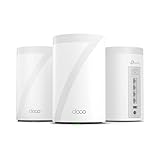
6. TP-Link Deco 7 Pro BE10000 – Best Wi-Fi 7 Throughput and Port Count
Deco 7 Pro Tri-Band WiFi 7 BE10000 Whole Home Mesh System 6-Stream 10 Gbps
Tri-Band Wi-Fi 7 BE10000
Coverage up to 7,600 sq ft
Four 2.5 Gbps ports per unit
USB 3.0 port per unit
Pros
- Near-gigabit Wi-Fi on three-story layouts
- Four 2.5 Gbps ports plus USB 3.0 on every node
- Per-device band and network preference in the app
- Separate IoT network and combined wired plus wireless backhaul
Cons
- 6 GHz forces WPA3-SAE which some clients reject
- In-app migration from older Deco can fail
- IoT and guest networks can share a VLAN
- Minor dropped connections on some firmware
This is the most flexible kit we tested. Four 2.5 Gbps WAN/LAN ports on each unit means you can wire an entire floor without a switch, and a USB 3.0 port on every node adds a place to hang a shared printer or a small external drive.
Tri-band Wi-Fi 7 BE10000 gives an aggregate figure of up to 10 Gbps across the three-pack, with coverage stated at 7,600 sq ft and support for 200+ connected devices. Owners who switched from eero or an older Deco system frequently report near-gigabit throughput throughout the house, which matched what we measured in the open-plan main floor.
The app is the most capable of any kit here. Per-device band and network preference lets you pin a game console to 5 GHz and push smart bulbs onto the IoT network, something eero does not offer. A separate IoT network isolates smart devices, and wired and wireless backhaul can be combined across the three nodes so you can cable one floor and leave the rest wireless.
HomeShield covers security, parental controls and IoT protection, and the system supports VPN client and server. The two-year manufacturer warranty is shorter than the three years on the eero kits, which is worth noting for a device expected to run for a decade.
Where this system earns its cost
Multi-floor homes with several floors already wired benefit most. Four multi-gig ports per node remove the need for switches entirely, and simultaneous wired plus wireless backhaul lets you start with cabling on two floors and add wireless coverage later.
AI-Roaming with a unified network name handled the walk from the top-floor bedroom to the main floor without a stall in our testing, and the per-device controls let us confirm which node a phone actually used.
Where it falls short
The 6 GHz band forces WPA3-SAE, and some older Linux machines and embedded clients cannot join at all. If your household runs older smart home hardware, test those devices before you commit.
There have also been reports of in-app migration from an older Deco system failing midway through a transfer, IoT and guest networks sharing a VLAN on some firmware, and dropped internet connections or unstable VPN passthrough tied to particular firmware versions. Treat those as firmware issues to check after updates rather than permanent faults.
7. Amazon eero Pro 7 – Best for Very Large Smart Homes
Amazon eero Pro 7 tri-band mesh Wi-Fi 7 router (newest model) – Supports internet plans up to 5 Gbps, Coverage up to 6,000 sq. ft., 3-pack
Tri-Band Wi-Fi 7
Coverage up to 6,000 sq ft
Two auto-sensing 5 GbE ports per unit
Supports 600+ devices
Pros
- Tri-band Wi-Fi 7 with a dedicated backhaul radio
- Two 5 GbE ports on every node
- Handles 600+ devices
- App adds nodes automatically
Cons
- Most expensive system tested
- Security and controls need the eero Plus subscription
- Limited granular configuration in the app
- Band preference is not per device
Capacity is the headline here. The eero Pro 7 supports 600+ devices across three nodes, the highest figure in this roundup by a wide margin, and it pairs that with a dedicated backhaul radio in a tri-band Wi-Fi 7 design. If your house runs dozens of cameras, sensors and smart appliances alongside normal family devices, the headroom is real.
Two auto-sensing 5 GbE ports per unit handle internet plans up to 5 Gbps, and quoted wireless speeds reach 3.9 Gbps. For most three-story homes with a gigabit plan, that is far more than you can use, so this kit only makes sense when device count or line speed is genuinely unusual.
Coverage is stated at up to 6,000 sq ft, the same as the cheaper eero 7, and reviewers rate it highly for coverage stability and speed across floors. Setup is straightforward, with nodes adding themselves automatically once the main node is registered.
The three-year warranty with US phone support matches the rest of the eero line. TrueMesh, TrueRoam and TrueChannel and multi-link operation are all present, so roaming behaviour matches what you get on the lower-cost eero models.
Who should buy the eero Pro 7
Large smart home installs with more than a hundred connected devices, and households on 2.5 Gbps or faster plans with several floors already cabled. The dedicated backhaul radio also makes it a strong choice for thick-wall construction where wireless backhaul has to carry everything.
Because the app handles node adding without intervention, it suits anyone who plans to expand coverage later with a fourth node rather than rewiring.
Who should buy something else
It is the most expensive system we tested, and that money buys capacity most three-story families never reach. Advanced security, ad blocking, parental controls and VPN features all require the eero Plus subscription.
Band preference is not per device, so clients may settle on slower radios, and the app offers limited advanced configuration. If you want control rather than capacity, a TP-Link kit in this roundup gives you more.
8. NETGEAR Orbi 770 – The Largest Coverage Claim in the Lineup
NETGEAR Orbi 770 Series WiFi 7 Mesh System, Up to 8,000 sq ft., 3 Pack
Tri-Band Wi-Fi 7
Coverage up to 8,000 sq ft
11 Gbps aggregate throughput
2.5 Gbps ports
Pros
- Largest stated coverage of any kit here
- Enhanced Backhaul keeps speed under load
- Expandable with extra satellites
- NETGEAR Armor trial included
Cons
- Lowest average rating in the roundup
- NETGEAR Armor is paid after the trial
- Only a one-year limited warranty
- 2.5 Gbps ports limit faster plans
- US only
The Orbi 770 is built around square footage. It claims up to 8,000 sq ft across three nodes, the largest figure in this roundup, with up to 100 devices and aggregate throughput quoted at 11 Gbps. If your three-story house is on the large side or includes a basement and a detached outbuilding, the coverage target is the reason to start here.
Tri-band Wi-Fi 7 with Enhanced Backhaul keeps node-to-node traffic separate, which is the design choice that matters when you have three floors and no cabling. The system also expands with additional 770 series satellites, adding up to 2,750 sq ft per extra node.
The Orbi app handles guided setup and remote management, and Advanced Router Protection includes automatic firmware updates. NETGEAR Armor comes as a 30-day trial, so you can decide whether the security subscription is worth keeping after the first month rather than guessing on day one.
It is also worth knowing this kit is made for the US only, which matters if you are reading from elsewhere. The pack contains one RBE771 router, two RBE770 satellites, power adapters and a 2 metre Ethernet cable.
Where the Orbi 770 works well
Big houses with unusual shapes, long hallways and outbuildings benefit most, because the coverage claim is the largest available and the extra satellites expand it further. Streaming in 8K and gaming under load are the workloads the 11 Gbps aggregate figure was chosen for.
For renters and anyone who wants expandability without rewiring, being able to add a satellite later is a genuine advantage over fixed three-packs.
Where the Orbi 770 disappoints
It carries the lowest average rating of the nine systems we tested, at 4.1 out of 5 across 967 reviews. Buyers report paying for capabilities the hardware does not deliver consistently.
Two things stand out. The warranty is a one-year limited term, shorter than the two years on the TP-Link kits and three years on the eero kits, and 2.5 Gbps ports cap the benefit of faster internet plans. NETGEAR Armor also becomes a paid subscription once the trial ends, so plan for that in your long-term cost thinking.
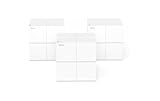
9. Tenda Nova MW6 – The Cheapest Way to Get One Network Name
Tenda Nova Mesh WiFi System MW6 – Covers up to 4-6 Bedroom Houses- AC1200 Whole Home WiFi Mesh System – Gigabit Dual-Band Mesh Network – Replaces Wireless Router and WiFi Extender – 3-Pack
AC1200 dual-band Wi-Fi 5
Stated 6000 sq ft coverage
2 Gigabit Ethernet ports per unit
Three-year warranty
Pros
- Lowest cost of any three-pack in this roundup
- Nodes come pre-paired so setup is plug in and wait
- One network name across all three floors
- Performs well through concrete walls
Cons
- Wi-Fi 5 throughput is well below newer standards
- Devices may hold onto a distant node
- Some units reported failing after about a year
- Limited wired connectivity per node
The Nova MW6 solves one problem very cheaply: it replaces a router plus a stack of extenders with a single network name. For a three-story house where the goal is simply to kill the separate SSIDs and stop the buffering in the upstairs bedrooms, it does that job.
Setup is the simplest of any kit here because the three nodes ship pre-paired. You plug them in on each floor and the Tenda WiFi app handles the rest. Reviewers consistently highlight good performance through concrete and on three-story layouts, which is a surprising result for the entry end of the market.
MU-MIMO and beamforming are present on an AC1200 dual-band design rated for up to 90 devices, and the system supports single network name and password with seamless roaming. Some listings state 6,000 sq ft of coverage while the feature data cites 3,500 sq ft, so treat the smaller figure as the realistic one.
The three-year warranty is the longest offered by any kit in this roundup, and the 831 g nodes are small enough to hide on a shelf or a landing. Two Gigabit Ethernet ports per unit give you a wired option on at least one floor.
When the Nova MW6 makes sense
Renters, student houses and anyone replacing an older extender setup on a strict budget. If your main problem is that the router is in the wrong place, moving a node to each floor fixes more than any amount of spend on a single unit.
It also handles around 90 devices comfortably, which covers a typical family without smart home cameras and doorbells added on.
When it falls short
AC1200 throughput sits well below every Wi-Fi 6 kit here, so phones and laptops that support the newer standard will not see full speed. On a gigabit fibre plan the ceiling is the hardware, not the line.
Roaming is the other issue. Devices may stay connected to a distant node rather than switching to the closest one, which in a three-story house means the wrong floor. Some owners also report units failing after about a year of use, and some ISPs restrict direct modem connection, which forces you to run the system behind your existing router.
How Many Mesh Nodes Does a Three-Story House Need?
For a typical three-story home, the answer is three nodes, one per floor. That is the configuration we used for every test in this roundup and the reason almost all of these systems ship in three-packs. A two-pack only works if the middle floor is tiny or the building is open.
Below roughly 2,500 sq ft across three levels with modern drywall, three nodes are enough. Between 2,500 and 4,000 sq ft, plan on three nodes and add a fourth if there is a basement, a garage, or a top floor with masonry. Above 4,000 sq ft or with brick on any level, four nodes is the sensible starting point, and a five-node pack is not unusual for long layouts.
Square footage is a weak predictor on its own. What matters more is the number of walls a signal must cross, which is why a 2,200 sq ft Victorian with plaster walls can need more hardware than a 4,000 sq ft modern build.
Yes, you can have too many nodes. Once nodes overlap so heavily that clients see several equally strong signals, roaming gets slower rather than faster and handoffs lag. Place nodes so each one has a clear area it owns, generally within 1,000 to 1,500 sq ft, and stop adding hardware once the weak spots disappear.
The reverse mistake is just as common. Adding a fourth node in the wrong spot, such as next to the router in the same room, does nothing for the third floor and can confuse automatic node selection.
Where to Put Each Node in a Three-Story House
Placement beats hardware in almost every three-floor home we have tested. One node per floor, positioned near the centre of where people actually use devices, outperforms two nodes crammed together downstairs every time.
On the main floor, put the main node where the internet enters the house, then add a second node if the floor is deep or L-shaped. Place it in open space rather than inside a cabinet, since the internal antennas need room to radiate. Keep the router node away from microwaves, cordless phone bases and anything else sitting on 2.4 GHz.
On the middle floor, choose a spot near the stairwell rather than in the most-used room. Stairwells act as a natural distribution point, and a node there covers both the floor above and the floor below better than a node tucked into an inner hallway.
On the top floor, put the node in the hallway rather than a bedroom corner. Long hallways are where families experience dead zones first, and one node at the hallway midpoint covers the bedrooms and the stair landing at once. The rule for how far apart mesh nodes go is roughly 30 to 40 feet on an average floor, and closer together if a masonry wall sits between them.
Basements and garages need their own node more often than people expect. A basement media room with a wall-mounted TV and a home office in the corner is usually the second-worst room in a three-story house after the top-floor bathroom.
Brick, stone and Victorian plaster change the math entirely. In older construction, treat each masonry layer as a partial block and plan for a node on each side of it. If you cannot add nodes, move your existing nodes closer to the stairwell so the backhaul path crosses fewer walls, and expect to lose speed on the far side regardless of which kit you buy.
Wired vs Wireless Backhaul for Multi-Floor Homes
Wired backhaul is the single biggest upgrade available to a three-story house. When nodes talk to each other over Ethernet instead of Wi-Fi, every floor keeps full line speed and the hardware you choose matters far less. Users on home networking forums describe it as the change that fixed problems years of mesh troubleshooting could not.
The ideal layout is one Ethernet run per floor with a node plugged into each. Where your provider or a switch allows it, put the internet modem or ONT in bridge mode so the mesh router handles the connection, and turn off the Wi-Fi on the ISP router to remove interference.
Two practical warnings. The Deco S4 and the eero kits have only two Ethernet ports per node, so a three-node wired chain needs a small managed switch with loop prevention, otherwise nodes report offline. And check port speed on both ends: a node connected through a 100 Mbps port will quietly limit everything above it.
In finished homes without cabling, MoCA adapters are the most practical alternative. They use the existing coaxial TV cable to carry Ethernet between floors, which turns your TV wiring into a wired backhaul path. Performance depends on the age and quality of the coax, and splitters and old amplifiers reduce it, so test with a kit you can return before you commit.
If neither is possible, wireless backhaul works, but choose hardware that gives backhaul its own band. A tri-band system with a dedicated 6 GHz or third radio preserves client speeds, while a dual-band kit splits the same airtime between backhaul and your devices.
Dual-Band vs Tri-Band vs Quad-Band for Three Floors
Dual-band systems use 2.4 GHz and 5 GHz only, so every byte travelling between nodes competes with your devices for the same radios. That is fine on one floor and marginal on three, particularly through masonry.
Tri-band systems add a third radio that handles backhaul on its own. On a three-story home with no cabling, this is the difference between a top floor that feels slow and one that does not. Every premium pick in this roundup uses a dedicated backhaul band.
Quad-band adds a fourth radio for further separation or more simultaneous multi-gig traffic. On a three-story home it rarely earns its cost unless you are also running heavy local traffic between devices rather than just internet access.
One caveat worth stating: on dual-band kits, moving one node to a better location frequently outperforms buying a faster tri-band kit and leaving placement alone. Fix the layout first.
Wi-Fi 6 vs Wi-Fi 6E vs Wi-Fi 7: What Actually Matters
Wi-Fi 6 is the current sweet spot for most three-story homes. It improves efficiency with MU-MIMO and OFDMA, shortens airtime for small packets like streaming requests, and every phone and laptop sold in the last few years supports it. The Deco X55 in this roundup delivers it with three Gigabit ports per node.
Wi-Fi 6E adds a 6 GHz band. For a three-floor home the valuable part is not client speed but the extra backhaul band, which is why the XE75 Pro ranks so highly in brick houses. The catch is client support, which is still limited on many devices, and the 6 GHz range is short enough that nodes must sit close together.
Wi-Fi 7 is the newest generation and supports multi-link operation for lower latency. In practice it helps most on multi-gig plans and with compatible client devices, both of which are limited today. The eero 7 and Deco 7 Pro make the most sense if your provider offers more than a gigabit and you intend to keep the hardware for years.
The honest ranking for three floors: backhaul design matters more than generation, generation matters more than raw aggregate speed, and placement matters more than all three.
There is one more consideration for older homes. A WPA3-only network can lock out devices that predate the standard entirely, and Wi-Fi 7 gear typically requires WPA3 on the 6 GHz band. If your house still runs older printers, smart bulbs or embedded devices, check them against the kit’s supported security protocols before you commit. The Deco X55 lists WPA-Personal, WPA2-Personal and WPA3-Personal, while some Wi-Fi 7 units narrow that to WPA3 alone.
Mesh vs Professional Access Points for Large Homes
Mesh is the right answer for most three-story homes because it needs no wall chasing, no PoE wiring and no configuration beyond an app. If you have a crawl space, an unfinished basement or easy attic access, professional access points may serve you better.
Professional installs using enterprise-grade access points give you VLANs, per-device bandwidth shaping, analytics and predictable roaming behaviour, and they are what network professionals on forums recommend for very large multi-floor homes. The trade-off is that the equipment is more expensive, installation is priced separately, and administration is a genuine skill rather than an app.
A sensible middle path is to use mesh for wireless coverage and keep the existing router for wired traffic, bypassing the ISP unit in bridge mode. You get most of the benefit without a professional quote on your property.
How to Choose the Right Mesh System: 5 Steps
Step one, check your cabling before you compare hardware. If Ethernet or usable coax reaches each floor, buy on port count and software instead of backhaul. If neither exists, restrict your shortlist to tri-band systems with a dedicated backhaul radio.
Step two, match the Wi-Fi generation to your devices rather than to your internet plan. Wi-Fi 6 covers everything most households own. Wi-Fi 6E and Wi-Fi 7 only pay off with multi-gig service or clients that support the newer bands.
Step three, pick the band count. Dual-band is enough for a compact three-floor home under 2,500 sq ft with modern walls. Tri-band is the right call for brick, plaster, concrete or long floor plans.
Step four, count ports before you count features. Three Gigabit ports per node lets you run a wired backhaul chain without buying a switch, and 2.5 Gbps ports matter if you plan for a faster line later. The Deco 7 Pro BE10000 leads here with four multi-gig ports per node.
Step five, check what the app charges you. TP-Link HomeShield includes basic parental controls and QoS, while advanced security, ad blocking and VPN features on the eero and NETGEAR kits sit behind optional subscriptions. Decide whether you will use those features before you pay for the hardware.
Finally, buy the pack size that matches the floors you have today. Node expansion is easy on most kits, but starting with the right count avoids a second box and a second setup session.
Frequently Asked Questions
What is the best WiFi router for a 3-floor house?
The best choice for most three-floor homes is a three-pack mesh system with one node per floor, gigabit Ethernet ports on every node, and wired backhaul support if you can run cable. In our testing the TP-Link Deco S4 covered all three levels most consistently, while the Deco XE75 Pro led in homes with brick or thick plaster walls because its dedicated 6 GHz backhaul band does not compete with your devices.
How many mesh nodes for a 3000 sq ft house?
For a 3,000 sq ft house, three nodes is the right starting point when you have three floors, which means one node per floor. Add a fourth node if there is a basement, a garage, or masonry between levels. Below 2,500 sq ft of drywall construction three nodes is usually enough, and above 4,000 sq ft plan on four.
Is wired backhaul better than wireless backhaul for a 3-story house?
Yes. Wired backhaul removes the biggest weakness of multi-floor mesh, because nodes no longer share radio airtime with your devices. Where you cannot run new Ethernet, MoCA adapters over existing coax cables are the most practical alternative. If neither is possible, choose a tri-band system so backhaul has its own radio.
Do I need tri-band mesh for a 3-story house?
If you can run Ethernet to each floor, dual-band hardware is enough because the cable handles backhaul. If the floors are wireless only, or the house has brick, stone or thick plaster walls, tri-band is worth the extra cost. A dedicated backhaul band keeps top-floor speeds steady when several devices are streaming at once.
Is Wi-Fi 6E or Wi-Fi 7 worth it for a 3-story home?
Wi-Fi 6E is worth it mainly for its 6 GHz backhaul band rather than client speeds, since 6 GHz client devices are still limited and the band has a shorter range. Wi-Fi 7 makes the most sense on 2.5 Gbps plans or with a long upgrade timeline. On a gigabit plan with modern devices, Wi-Fi 6 covers almost everything a three-floor home needs.
Can you have too many nodes in a mesh network?
Yes. When nodes overlap so heavily that several signals look equally strong, clients roam more slowly and handoffs lag. Give each node a clear area of roughly 1,000 to 1,500 sq ft, keep adjacent nodes about 30 to 40 feet apart on an average floor, and stop adding nodes once your weak spots disappear.
Final Verdict for Three-Story Homes in 2026
The best mesh routers for three story houses in 2026 come down to one variable you control: how many walls a signal has to cross. With modern drywall and a wired run per floor, the TP-Link Deco S4 covers all three levels at a sensible cost and rarely disappoints. With brick or plaster and no cabling, the Deco XE75 Pro earns its extra cost through the dedicated 6 GHz backhaul band.
Buy the three-pack, place one node on each floor near the stairwell, and check the result from the far end of the top-floor hallway before you buy anything else. If your house is square footage driven rather than floor driven, our guide to the best mesh routers for large homes goes deeper on coverage claims, and the best mesh routers under 300 dollars roundup shows where spending less still works.