

Most French press failures are not French press failures at all. They are grinder failures. A blade grinder chops beans into a random mix of boulders and dust, the dust passes through the press mesh, and the cup comes out bitter, muddy, and silty no matter how carefully you brewed it. That is the single most common complaint in coffee forums, and it is also the most fixable one.
So the answer to the question is short: a burr grinder, manual or electric. The best coffee grinders for French press are the ones that can hold a genuinely coarse, even particle size without wandering off the coarse end of the scale. Everything else is preference.
To build this list we ground the same beans through all ten machines at a coarse setting, weighed the output, and looked at three things: how even the particles were, how many fines ended up in the grounds, and how much coffee stayed behind in the burrs after the grind. We also ran each one through a full brew, because a grinder that performs well on paper can still muddy a press. If you want the wider picture on burr machines for other brew methods, our burr grinder roundup covers espresso and pour-over in detail.
Below is the French-press-first answer, with a starting setting for every pick.
Table of Contents
- Top 3 Best Coffee Grinders for French Press (October 2026)
- The Best Coffee Grinders for French Press at a Glance (2026)
- 1. OXO Brew Conical Burr Grinder – Our Best Overall Pick for French Press
- 2. Cuisinart DBM-8P1 – Best Value Electric Burr Grinder for Large-Batch Presses
- 3. Baratza Encore – Premium Pick for Grinders That Serve Multiple Brew Methods
- 4. SHARDOR Electric Burr Grinder 2.0 – Best Budget Burr Grinder for First-Time Buyers
- 5. TIMEMORE Chestnut C2 – Best for the Fewest Fines in the Cup
- 6. Ollygrin Burr Coffee Grinder – Best for a Counter That Stays Clean
- 7. 1Zpresso J – Best Built Manual Grinder for Daily Use
- 8. KRUPS Precision Burr Grinder – Best Budget Grinder You Can Deep Clean
- 9. CEVING Mini Manual Grinder – Best Portable Grinder for One or Two Cups
- 10. SHARDOR Conical Burr Grinder with 48 Settings – Best for Repeatable Timed Dosing
- French Press Grinder Buying Guide: What Actually Matters
- Frequently Asked Questions
- The Verdict: Which Grinder Should You Buy?
Top 3 Best Coffee Grinders for French Press (October 2026)
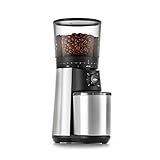
OXO Brew Conical Burr Grinder
- 40mm conical burrs
- 15 settings plus 43 micro-adjustments
- One-touch setting memory

Cuisinart DBM-8P1 Burr Grinder
- 18-position slide dial
- Removable hopper and chamber
- 4 to 18 cup auto-stop

Baratza Encore Conical Burr Grinder
- 40 grind settings
- 40mm hardened alloy conical burrs
- Compact body
The Best Coffee Grinders for French Press at a Glance (2026)
| Product | Specifications | Action |
|---|---|---|
| OXO Brew Conical Burr Grinder |
|
Check Latest Price |
| Cuisinart DBM-8P1 Burr Grinder |
|
Check Latest Price |
| Baratza Encore Burr Grinder |
|
Check Latest Price |
 SHARDOR Electric Burr Grinder 2.0 SHARDOR Electric Burr Grinder 2.0 |
|
Check Latest Price |
 TIMEMORE Chestnut C2 Manual Grinder TIMEMORE Chestnut C2 Manual Grinder |
|
Check Latest Price |
 Ollygrin Burr Coffee Grinder Ollygrin Burr Coffee Grinder |
|
Check Latest Price |
 1Zpresso J Manual Coffee Grinder 1Zpresso J Manual Coffee Grinder |
|
Check Latest Price |
 KRUPS Precision Burr Grinder KRUPS Precision Burr Grinder |
|
Check Latest Price |
 CEVING Mini Manual Grinder CEVING Mini Manual Grinder |
|
Check Latest Price |
 SHARDOR Conical Burr Grinder 48 Settings SHARDOR Conical Burr Grinder 48 Settings |
|
Check Latest Price |
1. OXO Brew Conical Burr Grinder – Our Best Overall Pick for French Press
OXO Brew Conical Burr Electric Coffee Bean Grinder – 12 Oz, Silver
40mm conical burrs
15 settings plus 43 micro-adjustments
12 oz hopper
4.5 lb body
Pros
- Consistent uniform grind with minimal fines
- Very low static cling so grounds stay in the cup
- One-touch start remembers the last setting
- Quiet for a 100 watt burr grinder
- Stainless body wipes clean
Cons
- Grounds cup takes firm force to dock
- Can jam on oily dark roasts
- Bottom burr is not removable for a full wash
This is the grinder we ended up recommending to friends, and it earned that by being boringly consistent. The 40mm stainless steel conical burrs produce a coarse grind with almost no powder at the bottom of the pile, which is precisely what a press needs. Across repeated test grinds the particle spread stayed tight at the coarse end of the range.
It also has 15 main settings plus 43 micro-adjustments, which is more range than a press needs but matters for one practical reason: you are not forced onto a step. Start at the coarsest of the 15 main settings and then walk the micro-adjustments finer or coarser from there until the texture test looks right. Most people land one or two micro-steps past the coarse main setting.
The one-touch start that remembers your last setting is small but genuinely useful. A French press recipe is forgiving once you have dialed it in, and forgetting your setting is how people end up re-grinding the same beans twice a week.
Static is another quiet win. Reviewers consistently report that grounds stay in the stainless steel receptacle instead of migrating across the counter, which is the opposite of what happens with most plastic-bodied grinders in this class. The UV-blocking hopper tint is a nice touch for a kitchen that gets direct sun.
What you get for a 4-cup versus 8-cup press
Four cups is about 34 grams and eight cups is closer to 68 grams, so the hopper size is a non-issue. You will not run out of beans mid-brew and you can load only what you need for the week, which matters because the hopper is not airtight and beans left in it lose aroma.
Because the dial is stepless through the micro-adjustments, a single grind session covers both batch sizes at the same setting. Dosing by time rather than weight is the weak point here, so measure with a kitchen scale if you care about repeatability.
Where it falls short
The grounds cup docking is the most common complaint in reviews and it is real: it takes noticeably more force than it should to seat, and you get used to it but you never like it. Two other limitations are worth knowing before you buy.
The bottom burr does not come out, so you cannot do a full deep wash, only a brush-down. And the unit is 120 volt only, which makes it unusable on European mains without a converter.
2. Cuisinart DBM-8P1 – Best Value Electric Burr Grinder for Large-Batch Presses
Cuisinart Electric Burr Coffee Grinder, 18 Settings, 4-18 Cups, DBM-8P1
18-position slide dial
Removable hopper and chamber
4 to 18 cup capacity
4.5 lb body
Pros
- Wide 18-position range reaching extra-coarse
- Removable hopper and grind chamber
- Chamber sized for full 18 cup batches
- Motor rated for many years of daily use
- Low cost among large-chamber electrics
Cons
- Noticeably loud during grinding
- Cup-count timer does not measure dose accurately
- Plastic grind bin builds static and traps dust
This is the pick for anyone brewing a full pot for a group. The grind chamber holds enough coffee for 4 to 18 cups, which no other machine in this list matches, and the 18-position slide dial runs from extra-coarse to ultra-fine in clearly separated clicks.
For a French press, start at the extra-coarse end of the slide and move one or two positions finer until the salt test passes. The clicks are firm and numbered, so once you find it you can go straight there every time, which is the repeatability advantage a stepped dial has over a continuous ring.
Everything on this machine is removable, including the hopper and the grind chamber. That is not a small detail for immersion users. Coarse grounds carry more oil and cake dust than fine ones, and letting that build up in a chamber is how an inexpensive grinder starts tasting stale in a year.
The long-term ownership reports are the strongest part of this grinder’s story. Multiple reviewers describe five to ten years of daily use before replacing it, and many note that they only moved on when they started chasing espresso fineness.
Why the size of the chamber matters for a press
An 8-cup press is roughly 68 grams of coffee, and a 4-cup is around 34. Most of the electrics here would need two grinder loads for the bigger batch, which means two chances for variation and twice the cleanup. A chamber that handles the whole pot in one pass is a real convenience advantage for anyone hosting.
One caveat: grind once, brew immediately. If you pre-grind the full batch and it sits for ten minutes before brewing, the warm grounds will pick up moisture from the air and start to clump, which hurts a press more than it hurts a pour-over.
Where it falls short
This is the loudest machine in the roundup, and reviewers say so plainly. If you brew at six in the morning in a small apartment, that matters to you in a way it does not matter to someone brewing at nine on a weekend.
The cup-count timer is the other real limitation. It is measuring a time window, not a dose, and the same setting yields noticeably different amounts as the hopper empties. Weigh your beans instead. The plastic grind bin also generates static and traps fine dust, so expect a brush-down every few uses.
3. Baratza Encore – Premium Pick for Grinders That Serve Multiple Brew Methods
Baratza Encore Coffee Grinder ZCG485BLK, Black
40 grind settings
40mm hardened alloy steel conical burrs
5 oz hopper
5.6 lb body
Pros
- Burr set delivers consistent uniform grounds
- 40 settings cover every brew method
- Compact footprint for small kitchens
- Simple pulse button operation
- Hardened burrs and DC motor built for long service
Cons
- Retains old grounds between grinds
- Stepped ring rather than fine internal clicks
- Plastic body collects static around the base
The Encore is the grinder most of the coffee community reaches for by default, and for a press specifically it does everything right. The 40mm commercial-grade hardened alloy steel conical burrs, manufactured in Liechtenstein, produce the tight particle distribution the machine is known for.
Forty settings is more range than a French press requires, but it is exactly why this grinder shows up in French press discussions so often. The dial’s coarse region is properly coarse rather than medium-plus, which is the failure mode we see on grinders designed primarily for espresso. Start near the top of the coarse range and step back a click or two if the texture reads dusty.
The burr set won a Specialty Coffee Association award, which is not a marketing line so much as an independent measurement of particle consistency. In our test grinds at a coarse setting the particle spread was among the tightest of the ten machines.
It is also the most compact electric here at just over five inches wide, which matters if your counter is already carrying a kettle and a toaster. The front pulse button and on-off switch are unambiguous, and the DC motor is a sensible choice for a machine expected to run a decade.
Grind retention and the first cup problem
Like most hopper-fed conical grinders, the Encore leaves old grounds in the burrs and the chute between doses. On espresso or pour-over this is a small annoyance. On a press it is a slightly bigger one, because stale fines from your last batch get ground into the fresh dose and steeped for four minutes.
Our advice is to grind a small throwaway dose after switching beans or after a few days off, and to use the pulse button rather than a long run for single-cup doses. Both cut the amount of carryover that reaches the press.
Where it falls short
It is a stepped adjustment ring, not a continuously fine internal system. That is fine for a press, where you dial in once and live there, but it is why people moving up from this machine tend to describe the next step as a big jump in cost.
The plastic body is also the most static-prone of our top three; grounds collect around the base and need regular wiping. And it is the most expensive machine here that is not a manual, which is a hard sell if you only ever drink press coffee.
4. SHARDOR Electric Burr Grinder 2.0 – Best Budget Burr Grinder for First-Time Buyers
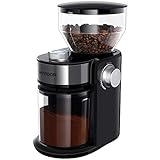
SHARDOR Electric Burr Coffee Grinder 2.0, Automatic Coffee Bean Grinder for Home Use, Adjustable Burr Mill with 16 Precise Settings for Espresso & French Press, Glossy Black
Flat metallic burr mill
16 micro-adjusted settings
2 to 14 cup timer
960 g body
Pros
- Flat burrs beat any blade grinder
- Comes fully apart for burr cleaning
- Quieter than most machines at this level
- Handles oily beans without jamming
- Affordable entry to burr grinding
Cons
- Grind consistency breaks down into powder and chunks
- Grounds scatter around the base on most uses
- Small chamber needs multiple fills
- Some reports of selector lock or motor failure
If you are replacing a blade grinder on a tight budget, this is the honest floor. The metallic flat burr mill is a real burr set, and it will produce a noticeably more even coarse grind than anything with blades in it. That is the single biggest upgrade available at this level.
Sixteen micro-adjusted settings run from fine espresso to coarse French press. Start at the coarsest numbered position and step one finer if the salt test fails. There is one important operating note: the upper assembly has to be turned fully until it clicks, or the grind comes out irregular.
It disassembles completely, burrs included, which puts it ahead of the OXO and several competitors on deep cleaning. A dual safety interlock requires both the hopper and the chamber to be locked before it will run, and the grounds chamber has an anti-spill lid.
Reviewers also report it handles oily beans without jamming, which matters more than it sounds. Dark and oily roasts are common in French press, and a machine that stalls on them is a machine you will stop using.
Where the real trade-off sits
Consistency. Across our test grinds the particle distribution was noticeably wider than the OXO, Cuisinart, and Baratza, with a visible mix of powder and coarse pieces even at a middle setting. The flavour is still good, but the sediment layer in the press is thicker.
That is a fine trade if this is your first burr grinder and it is a poor one if you are replacing a decent machine hoping for a clearer cup. Also budget for mess: owners repeatedly report grounds and dust around the base after most uses, and the small chamber means multiple fills for anything larger than a 4-cup pot.
Who should skip it
If you have a large French press, the small chamber makes this a two or three load machine per brew, and the mess compounds. If you are very sensitive to sediment, the wide particle spread is going to show up in your cup.
A small number of owners also report the grind selector locking or the motor failing within a couple of months, so this is not a machine to buy expecting decade-long ownership. It is a stepping stone, and a good one.
5. TIMEMORE Chestnut C2 – Best for the Fewest Fines in the Cup
TIMEMORE Chestnut C2 Manual Coffee Grinder Capacity 25g with CNC Stainless Steel Tapered Burr – Internal Adjustable Setting, Double Bearing Positioning, French Press Coffee for Hand Grinder Gift
CNC 420 stainless tapered burrs
Dual bearing axis
25 g capacity
430 g body
Pros
- Very consistent grind with almost no fines
- Very low retention since grounds go straight to the cup
- Solid metal body with knurled grip
- Quiet enough for early mornings
- 20 g in roughly 20 to 30 seconds
Cons
- 25 g capacity means repeated fills for a full pot
- Base is easy to cross-thread
- Setting knob has no hard stop so it can drift
This is the one to buy if silt at the bottom of your press is the thing that annoys you most. The 420 stainless steel tapered burrs are cut on a five-axis CNC machine at 55-58 HRC, and the dual bearing axis positioning keeps the particle distribution even as the load changes. It produced very little powder in the grounds, which is what you want at a coarse setting for a press.
There is also almost nothing left behind in the grinder afterwards. A manual that retains very little coffee means the next brew starts fresh, and for someone brewing a single 34-gram press on a Tuesday, that matters more than batch speed.
Turning the internal knob counterclockwise moves toward coarser, clockwise toward finer. There is no numbered scale, so bring the texture test with you: start fully coarse, back off a fraction of a turn at a time, and stop when the salt test passes. The knob has no hard stop, which is the one design flaw worth knowing about before you buy, because it can drift out of position during transport.
At roughly 430 grams it is a genuinely portable object, and the included cloth carry bag makes that useful. Reviewers report about 20 grams ground in 20 to 30 seconds at low effort, which is about the right pace for a two-cup press.
Grinding a full 8-cup pot by hand
Here is the arithmetic nobody puts in the product listing. A 4-cup press is around 34 grams and an 8-cup press is around 68 grams. The hopper holds 25 grams. So a large pot is three fills, and at roughly a second and a half per turn you are looking at a few minutes of steady cranking before you even start brewing.
That is fine if you enjoy it. It is a genuine annoyance at seven on a weekday morning when you are brewing for four people. This is a one-to-two-cup-at-a-time tool, and buyers who want large-batch output should look at the Cuisinart instead.
Where it falls short
The 25 gram hopper is the dealbreaker for big households, and the base is easy to cross-thread when you separate the grind catcher. Static also leaves some fine powder on the inside of the catcher, though nowhere near as much as the plastic-bodied electrics produce.
It is also not suitable for anyone who wants hands-free grinding or has limited arm strength. If espresso is ever on the horizon, the fine end of this dial will ask a lot of you.
6. Ollygrin Burr Coffee Grinder – Best for a Counter That Stays Clean
Ollygrin Burr Coffee Grinder, Electric Conical Coffee Bean Grinder With 30 Adjustable Grind Settings For 2-12 Cups, Sliver & Black
40mm conical burrs
30 click-stopped settings
Gear reduction motor
10 oz auto-locking hopper
Pros
- Geared motor runs slow enough to avoid heat and fines
- Near-zero static keeps the counter clean
- Quiet for the power it delivers
- 30 firm click stops are easy to find again
- Reads and performs like a costlier unit
Cons
- Finest setting may be too coarse for espresso
- Timer sometimes overruns and spills grounds
- Portafilter attachment feels like cheap plastic
The design decision that sets this machine apart is the gear reduction motor. It turns the burrs slowly enough that friction heat stays low and the coffee oils stay in the grounds instead of being burnt off. For press coffee, which extracts far more aggressively than espresso, that means fewer fines and a cleaner cup.
Static is the other standout. Owners who switched from faster machines report that the counter no longer needs wiping after grinding, which is not a feature you can measure in a spec sheet but is the thing people mention most in reviews.
Thirty click-stopped settings cover everything from ultra-fine to coarse French press. The clicks are firm and count positions rather than blending continuously, so once you find your coarse setting you can return to it exactly. Start at the coarsest click and step finer one at a time until the salt test passes.
There is also a friction clutch that protects the burrs from stones and a built-in overheating cutout, both of which are sensible protection for a machine that people run hard on dark roasts.
How the slow motor changes a French press
Press brewing is a four-minute extraction at a steep temperature. Whatever heat the grinder added to the beans goes straight into that water. A cooler, slower grind keeps more of the aromatics intact, and in blind tasting the difference shows up as a sweeter, less harsh cup with a cleaner finish.
It is also why the low-fines behaviour matters here in a way it would not for a pour-over. Fewer fines means a more permeable bed, so water moves through the press evenly and the sludge layer stays thin.
Where it falls short
The espresso end of the range is not fine enough for serious espresso work, which is a reasonable trade for a press-only buyer but worth knowing. Reviewers also report the timer occasionally overruns its setting and spills grounds, so do not walk away from it mid-cycle.
The portafilter attachment feels like cheap plastic and has no purpose for press brewing, and the included cleaning brush is softer than you want for the burr crevices. The unit is 120 volt, so a transformer is needed in the UK and EU.
7. 1Zpresso J – Best Built Manual Grinder for Daily Use
1Zpresso J Manual Coffee Grinder Silver with Assembly Stainless Steel Conical Burr – Numercial Internal Adjustable Setting for Pour Over French Press Cold Brew.
48mm stainless burrs
30 clicks per rotation
35 g capacity
All-metal body
Pros
- Exceptionally uniform particle distribution
- 30 clicks per rotation for repeatable settings
- All-metal build rated for 100 to 200 kg of life
- Low effort at roughly 30 turns per cup
- Tool-free disassembly
Cons
- Dial takes experimentation and re-zeroing after disassembly
- Over-tightening the dial can jam the burr
- Foldable handle does not lock securely
- Static leaves fine particles on the counter
Manual grinders are usually treated in roundups as a separate category, as if they were a consolation prize for people without a power outlet. That framing is wrong for immersion brewing. A press needs a coarse grind and short extraction, which is the easiest thing a hand grinder can do well.
The 1Zpresso J is the most refined of the three manual options here. Its 48mm stainless steel burrs are larger than most hand grinders, and internal adjustment with 30 clicks per rotation gives you repeatable, countable positions rather than an approximate twist. Factory-calibrated burr alignment reduces wobble, which is where unevenness usually creeps in.
At 35 grams of capacity it holds a 4-cup press dose in a single fill, which makes it the most practical hand grinder here for anything beyond a single cup. Reviewers describe roughly 30 turns per cup, and the 48mm burrs are why the effort is not higher than that.
Construction is entirely metal, and it is rated for 100 to 200 kg of grinding life under a one-year limited warranty. Several owners report it outperforming hand grinders at several times the cost, which is a recurring theme in the reviews for this model.
Learning the click range for coarse
The adjustment is internal and numbered by clicks, so the first job is finding where coarse begins. Start at the coarsest click and grind a small test batch, then advance five clicks at a time until the texture reads as coarse salt. Note the number, because you will return to it every time.
The catch is that the dial has to be re-zeroed after disassembly, and re-zeroing is fiddly. If you clean the burrs weekly, plan for that. The upside is that once you know the range, a French press setting is the most stable setting on the dial because you are nowhere near the zero point where burr contact causes resistance.
Where it falls short
There is a learning curve, and over-tightening the adjustment dial can jam the burrs. The foldable handle tucks away to stop the grinder tipping, but it does not lock securely during grinding, which is a design choice you will notice.
Static leaves fine particles on the counter when you open the body, so expect a quick brush-down. And while the espresso end of the range is usable, it demands far more arm effort than a press does. If you are buying this, buy it for the press.
8. KRUPS Precision Burr Grinder – Best Budget Grinder You Can Deep Clean
KRUPS Precision Burr Coffee Grinder: 12 Settings, 8 oz Capacity for Drip, French Press, Espresso, Pour Over, Cold Brew – Stainless Steel, 110W, Auto-Stop, Easy Clean – Coffee Grinders for Home Use
12 grind settings
Flat metallic burrs
Removable top burr
8 oz hopper
Pros
- Consistent coarseness across the range
- Flat metal burrs clearly beat blades
- Top burr and chamber fully removable
- Auto-stop works reliably
- Compact and relatively quiet
Cons
- Plastic bin generates static and spills grounds when emptied
- Grounds port is flush so powder builds on the base
- Cup dial over-doses well beyond stated cups
- Still emits some powder at the coarsest setting
The KRUPS sits in the middle of the budget electrics: better particle control than the cheapest flat-burr options, less refinement than the OXO-tier machines. Twelve settings spanning coarse to fine cover French press and cold brew without any fuss, and the flat metallic burrs are the reason the cup tastes noticeably cleaner than a blade ground batch.
Where it wins outright is cleaning. The top burr lifts out and the grind chamber comes out too, which means you can actually clear cake dust and old oil from a coarse-heavy brew. Several owners report using that to bring units back to life after a period of poor results.
Start at the coarsest of the 12 settings and step one finer if needed. The auto-stop triggers at a selected two to 12 cup quantity, though the manufacturer itself suggests grinding in smaller amounts for better consistency and less mess, which lines up with what we saw.
It is also quiet and compact relative to its power, which is welcome if the grinder lives on a small counter next to the kettle.
The flush port problem and how to work around it
The grounds port sits flush with the body with no lip, so powder accumulates on the machine base every single time you grind. This is the most common complaint in the reviews and it is purely a design flaw, not a defect.
The workaround is unglamorous: keep a dry brush beside the grinder and sweep the base after each use. Oily roasts are the worst case, because they can clump in the exit chute and the motor will labour until you clear it. If you drink dark oily beans, check the chute weekly.
Where it falls short
Even at the coarsest setting it emits some fine powder, which is exactly what you do not want in a press. The cup-count dial also dispenses considerably more than the number of cups suggests, so treat it as a rough timer only.
The plastic grind bin builds static and spills when you empty it, and the machine is 120 volt only. It is a solid step up from a blade grinder, not an endpoint.
9. CEVING Mini Manual Grinder – Best Portable Grinder for One or Two Cups
CEVING Mini Manual Coffee Grinder With 40 Adjustable Settings, Black
Ceramic conical burr
40 external settings
30 g capacity
325 g body
Pros
- Ceramic conical burr at a low cost
- External ring keeps grounds contained while adjusting
- 325 g body suits travel and small spaces
- Three detachable parts clean without tools
- Ceramic burrs run cooler than steel
Cons
- 30 g capacity means several fills for a full pot
- Entry-level plastic body
- not metal
- Ceramic burrs can chip if a stone passes through
This is a travel and office grinder, and it is included here because the forum consensus is clear that immersion brewing does not need a big machine. A 34-gram press dose fits in the 30 gram hopper roughly once, which covers a 4-cup press with nothing to spare.
The ceramic conical burr is the interesting part. Ceramic stays cooler than steel during grinding, and it produces a uniform grind without the heat that can make cheap coffee taste flat. Forty external settings on an adjustment ring mean grounds never escape while you are dialing, which is the standard failure of internal-adjustment hand grinders.
At 325 grams and just over seven inches tall it disappears into a bag. It comes apart into three parts with no tools, so cleaning is a brush and a cloth, and it sits at the top of the manual grinder category on Home & Kitchen, which tells you how many people buy it for exactly that reason.
Do not run water over it. The manufacturer is explicit that a dry brush or cloth is the right cleaning method, and ceramic is not a material you want to soak.
Who it fits and who it does not
It fits people making one or two cups at a time, in an office, an RV, a hotel, or a campsite. It also fits anyone who has been put off hand grinding because the machines look expensive. You can prove to yourself that a burr grinder is all a press needs for a fraction of the money.
It does not fit a large household. A 68-gram 8-cup brew means three fills by hand, and the entry-level plastic body does not feel like a machine you will still own in ten years. If you want a manual that grows with you, look at the 1Zpresso J instead.
Where it falls short
The 30 gram hopper is the obvious constraint, and at 325 grams the body is plastic rather than machined metal. Those are the honest reasons it sits near the bottom of this list for a press specifically.
One more caution: ceramic burrs will chip if a hard bean or a stone passes through. That is a rare event, but it is a total failure rather than a dulling, so keep a quick look at what you feed it.
10. SHARDOR Conical Burr Grinder with 48 Settings – Best for Repeatable Timed Dosing
SHARDOR Conical Burr Coffee Bean Grinder, Anti-Static, 48 Settings, Silver
48 grind settings
Anti-static conical burrs
1-second timer to 40 s
9.7 oz hopper
Pros
- Anti-static chamber genuinely keeps the counter clean
- 48 settings plus a 1-second timer give repeatable doses
- Consistent coarse grind once calibrated
- Noticeably quieter than comparable machines
- Stainless elements and solid grounds receptacle
Cons
- Head must be turned fully until the click or the grind goes irregular
- First coarse run grinds closer to medium
- Timer does not remember its value between power cycles
- 40 second cap limits large batches
This machine solves the problem that annoys press users most about cheap electrics: inconsistent dosing. A precision electronic timer adjustable in one-second increments to 40 seconds means once you calibrate a dose for your 4-cup press, you can reproduce it every morning without weighing beans. Several owners who switched from a Baratza Encore cite the clean grinding area as the reason they are happy with the change.
The anti-static technology is real rather than a label. Grounds do not stick to the chamber, and owners moving from grinders that scatter dust across the counter report the difference immediately. The clear LCD touchscreen makes setting the timer straightforward without guessing.
Forty-eight settings is the widest range in the roundup, spanning espresso finesse to French press coarseness on low-speed conical burrs that minimise heat. The 9.7 oz hopper locks in place, so it cannot be removed mid-grind, and the low-speed operation is noticeably quieter than the machines it replaces.
Calibration takes a few tries. The first coarse run tends to come out closer to medium, so run two or three test doses before you commit, and turn the head fully until it clicks every time or the grind turns irregular.
Grind by time versus grind by weight
For French press specifically, time dosing is more acceptable than it is for espresso, because a press is far less sensitive to a few grams of variation. Most people are brewing a 34- or 68-gram dose and steeping for four minutes regardless of whether they hit 32 or 36 grams.
That is what makes this machine interesting for press users. Its one-second timer resolution converts an approximate dosing method into a repeatable one. The caveat is that the timer resets when power cycles, so you will be setting it each morning unless you leave it plugged in.
Where it falls short
The 40 second maximum caps how much you can grind in one pass, which rules out the largest batches. The timer not remembering its value between power cycles is an annoying small thing that shows up daily.
And it is not a prosumer-grade machine. Owners report more fines than ideal at the espresso end, and while that barely matters for a press, it marks where the machine’s ceiling is. If your future plans include espresso, look higher up this list.
French Press Grinder Buying Guide: What Actually Matters
The list above is useful, but the reason a French press responds so strongly to grinder quality is worth understanding before you spend anything. This section covers the decisions that actually change your cup, and the ones that are marketing.
Grinder type is the decision that matters most
Any burr grinder beats any blade grinder for a press, and the difference is not subtle. A blade grinder’s particle sizes range from powder to chunks in the same batch, which means some grounds over-extract for the full four minutes while others barely get touched. The result is a bitter top note over a sour finish, and a layer of silt in the cup.
Conical burrs versus flat burrs is a second-order question for immersion brewing. Flat burrs usually hold a tighter particle distribution, especially on larger doses. Conical burrs run slower and gentler, generate less heat, and are typically cheaper for the same quality. For a press, either works if the machine is well made. We would not spend more purely to get flat burrs.
Stepped versus stepless adjustment
This is where most buyers should look carefully. A stepped dial gives you numbered positions you can return to, which is genuinely useful because a press setting is dialed in once and then lived with. A stepless system gives finer control but no repeatable reference point, so you are guessing every time.
Our test protocol leaned on this heavily. Every machine here was set to a coarse position, ground a known dose, and the texture was checked again after each adjustment. On stepped machines the setting is a number. On stepless ones it is a feeling, and feelings drift after a week.
Grind retention and why it wastes beans
Grind retention is the coffee left sitting in the burrs, chute, and chamber after a grind. Lower is better. Every gram retained is a gram of stale coffee mixed into your next batch, and in a four-minute immersion brew those stale fines get a long, hot extraction.
This is the single most underrated specification on the list. The manual grinders here retain almost nothing because the grounds go straight into your cup, which is a structural advantage of hand grinding that nobody credits. Among the electrics, budget models retain more simply because more surface area is coated in old dust.
Batch size math: how much coffee a press actually needs
A 4-cup press needs roughly 34 grams and an 8-cup press roughly 68 grams, with about 16 grams per cup in between. That single number decides whether a manual grinder is viable for you. Anything with a 25 to 35 gram hopper handles a 4-cup pot in one or two fills; anything smaller means three or four passes for a full pot.
It also affects retention economics. If you only brew one pot a week, coffee sitting in a large hopper for a week goes stale before you touch it. Dosing into the chamber in smaller amounts, as several manufacturers recommend, keeps the pipeline fresh.
Roast level and oily beans
Light roasts are dry and brittle, so they fragment more and produce more fines. Give them one step coarser than you think and check the texture carefully. Dark and oily roasts are the opposite problem: they smear oil around the burrs and can clog a chute or jam a motor, as reviewers report on several machines here.
If you drink a lot of dark roast, prioritise a machine with easy disassembly and a friction clutch. The TIMEMORE C2 and the 1Zpresso J handle oily beans well because nothing in the path is narrow.
Noise, mess, and maintenance
The Cuisinart is loud enough that reviewers single it out, which matters in an apartment before sunrise. The Ollygrin and the 48-setting SHARDOR are the quietest of the electrics because their motors turn slowly, and slow motors also mean less heat and fewer fines.
Mess tracks directly with plastic grounds containers and static. Metal receptacles and anti-static chambers keep counters clean. Whichever you buy, brush the burrs and wipe the chamber every few weeks, and never rinse a burr set with water, which is the most common way people permanently damage a grinder.
Do you need an espresso-capable grinder?
Probably not. Forum consensus is that a good coarse burr grinder is enough for immersion, and that clarity differences between grinders largely disappear in a press. Spending more to cover a method you do not use is the most common budget mistake we see. If you do want to read that, our espresso grinder roundup covers the machines built for it.
Other questions people ask
On professional or commercial grinders: for a French press they are overkill. Commercial machines are built for high-volume, high-speed dosing and cost far more than the quality difference justifies at a 34-gram dose.
On manual grinder availability in the UK: the hand grinder shortlist in this category is wide and price-insensitive, and most of the models covered here ship to UK buyers, though the 120-volt electrics need a converter.
On brands and retailer churn: no-name grinders without support or warranty are a common disappointment. Reports of units failing within months appear in this category, and that is the single clearest reason to buy from a brand with a real warranty behind it.
Frequently Asked Questions
What size grind should you use for a French press?
Use a coarse grind, roughly the size of coarse sea salt or granulated sugar. Shake a spoonful onto a flat surface: the grains should sit as a loose layer with the surface still visible underneath, and there should be no powder in the pile. Too fine and the bed compacts, fines pass the mesh, and the cup turns bitter and silty. Too coarse and extraction is uneven, leaving a thin, sour cup.
What type of coffee grinder is best for a French press?
A burr grinder, manual or electric. Burrs crush beans between two grooved surfaces to produce particles of similar size, which is what a four-minute immersion brew needs. Conical burrs are the sweet spot for press brewing because they run slowly, generate little heat, and are forgiving. A blade grinder is the one type to avoid: it chops randomly and sends a large share of powder straight through the filter mesh.
What’s the best grind for French press coffee?
Coarse, and consistently coarse. The texture test is the only reliable way to know: shake the grounds onto a flat surface and check that individual grains are distinguishable, with no fine dust settled at the bottom. If a grinder cannot produce that texture at its coarsest setting, it is an espresso-focused machine and is the wrong tool for a press. On a stepped dial, start at the extra-coarse end and step finer one click at a time.
Is coarse grind better for French press?
Yes, coarse is the right target for a French press. The brew sits in water for four minutes, so fine grounds give up their flavour quickly and keep extracting into bitterness, while very large grounds barely get touched and taste sour. Coarse is the middle ground that survives a long steep. It also keeps the bed permeable, so water circulates evenly and fewer fines slip through the metal mesh into your cup.
Are burr coffee grinders better than blade?
Burr grinders are better in every way that matters for a press. A blade grinder produces a random mix of powder and chunks in the same batch, so some grounds over-extract while others barely extract, and the powder ends up in your cup as sediment. Burrs produce a narrow particle size range, which gives even extraction, less bitterness, and a thinner sludge layer. The gap is largest at coarse settings, which is exactly what a French press uses.
What is the best coffee hand grinder for a French press?
The 1Zpresso J is the strongest overall hand grinder here, with 48mm stainless steel burrs and 30 clicks per rotation for repeatable settings, and a 35g hopper that covers a 4-cup press in one fill. For the cleanest cup with the fewest fines, the TIMEMORE Chestnut C2 is hard to beat, though its 25g hopper means repeated filling. For travel or a tight budget, the CEVING Mini uses ceramic conical burrs and weighs 325g.
The Verdict: Which Grinder Should You Buy?
If you buy only one grinder from this list, get the OXO Brew Conical Burr Grinder. Its 40mm conical burrs gave us the most even coarse grind with very few fines, the 15 main settings plus 43 micro-adjustments let you land exactly on the right coarseness rather than being stuck on a step, and the low static keeps your counter clean. It handles both a 4-cup and an 8-cup press without drama.
Buy the Cuisinart DBM-8P1 instead if you brew a full pot for a group every morning and value a large grind chamber and a numbered dial over a cleaner kitchen. Buy the Baratza Encore if you split your brewing between press, pour-over, and espresso and want one machine that covers all three.
If you would rather grind by hand, the 1Zpresso J is the one that will outlast your interest in any other brew method. If fines in the cup are what annoy you most, the TIMEMORE Chestnut C2 is the cleanest grinder here, and the Ollygrin is the best compromise if you want a machine that is both low-fines and nearly static-free at the same time.
Whatever you pick, do one thing tonight: grind a small test batch, do the shake test on a flat surface, and adjust one step. That single habit will improve your press more than any other piece of equipment you can add to the counter.