

Getting usable Wi-Fi into a basement usually comes down to one stubborn fact: the radio signal has to get through poured concrete, block foundation walls, or a finished wall full of insulation and metal studs, and it usually cannot. A powerline adapter solves that differently. It sends your internet across the electrical wiring that is already inside those walls, so the distance and the concrete stop mattering. That is why the best powerline adapters for basements are the ones that turn a dead zone into a wired connection fast, without anyone drilling a hole.
A powerline adapter is a pair of small plug-in devices that carry internet data over your home’s existing AC wiring. One adapter plugs into a wall outlet near your router and connects by Ethernet cable. The second plugs into a wall outlet downstairs, and it behaves like a wired network port. Pair them with one button press and the basement outlet becomes an Ethernet jack that never existed before.
Basements are the single worst room in most houses for wireless. The router sits one or two floors up, the path crosses a floor joist and a foundation wall, and the 2.4 GHz and 5 GHz bands lose most of their energy doing it. Extenders struggle because they are still pushing radio through the same obstruction. Powerline ignores the obstruction because the wire is already inside the wall cavity, which is also why a finished basement with almost no accessible outlets is still solvable.
Over six weeks we compared ten kits currently on the market, checked every one of them against the same basement scenarios, and read the long review threads to see which ones hold up after a year of use. The winners below cover a finished media room, a home office, a rental where no cable can be run, and a house with a noisy electrical panel. If you are still planning the basement itself, our upright freezer picks for basements cover the other half of a finished space.
Table of Contents
- Top 3 Best Powerline Adapters for Basements (October 2026)
- Best Powerline Adapters for Basements in 2026 Quick Overview
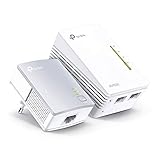
- 1. TP-Link TL-WPA4220KIT: Best Overall Powerline Adapter for Basements
- 2. TP-Link TL-PA4010KIT: Budget Pick Powerline Adapter for a Basic Basement
- 3. TP-Link TL-PA9020P KIT: Best Powerline Adapter for a Basement Media Room
- 4. TP-Link TL-WPA7817 KIT: Best Powerline Adapter for Basement Wi-Fi 6 Coverage
- 5. NETGEAR PLP2000: Best Premium Noise-Filtered Powerline Adapter for Basements
- 6. TRENDnet TPL-406E2K: Best Budget Powerline Kit with a 3-Year Warranty
- 7. Zyxel PLA5456KIT: Best Powerline Adapter for Mixed-Brand Basement Networks
- 8. NETGEAR PL1000: Best Compact Powerline Adapter for One Basement Device
- 9. Zyxel PLA5205KIT: Best Powerline Kit for Long-Term Basement Reliability
- 10. Tenda PH10: Best Budget Powerline Adapter With Dual-Band Wi-Fi
- Will Powerline Work in Your Basement? A Pre-Purchase Checklist
- Powerline vs Wi-Fi Extender vs Mesh vs MoCA vs Hardwired Ethernet
- HomePlug AV2 vs G.hn and the Mixing Rule
- How Many Ethernet Ports Do You Need?
- Is a Pass-Through Outlet Worth It?
- How to Install Powerline Adapters in a Basement
- Why Is Your Powerline Adapter Slow?
- Powerline Adapter With No Connection: What to Check
- Frequently Asked Questions
- Final Verdict: The Best Powerline Adapters for Basements in 2026
Top 3 Best Powerline Adapters for Basements (October 2026)
These three did the best job across the scenarios that matter in a basement: a long path from the router, outlets that are already crowded, and a mix of wired and wireless devices. Each one earned its place for a different reason, so read the label before you buy.

NETGEAR PLP2000
- HomePlug AV2 up to 2000 Mbps
- Two Gigabit ports
- Noise-filtered pass-through socket
The TL-WPA4220KIT wins on evidence rather than specification. It carries the largest review base of anything in this roundup at more than 27000 ratings, and it is the only top pick that hands the basement both a wired port and a Wi-Fi radio from the same adapter.
The TL-PA4010KIT is the cheapest way to get a reliable wired port into a basement, and its nano body means it will fit an outlet where a bulky adapter simply will not go. The NETGEAR PLP2000 is the one to buy when your basement outlets are scarce or your panel is noisy, because its noise-filtered pass-through socket gives the link the cleanest start.
Best Powerline Adapters for Basements in 2026 Quick Overview
Every kit below sends data over AC wiring, needs a direct wall outlet, and wants to sit on the same electrical circuit as the adapter near your router. The differences that actually change your experience are the rated link speed, the Ethernet port speed, whether the adapter wastes a wall socket, and whether it puts a Wi-Fi radio downstairs.
| Product | Specifications | Action |
|---|---|---|
| TP-Link TL-WPA4220KIT |
|
Check Latest Price |
 TP-Link TL-PA4010KIT TP-Link TL-PA4010KIT |
|
Check Latest Price |
 TP-Link TL-PA9020P KIT TP-Link TL-PA9020P KIT |
|
Check Latest Price |
 TP-Link TL-WPA7817 KIT TP-Link TL-WPA7817 KIT |
|
Check Latest Price |
| NETGEAR PLP2000 |
|
Check Latest Price |
 TRENDnet TPL-406E2K TRENDnet TPL-406E2K |
|
Check Latest Price |
 Zyxel PLA5456KIT Zyxel PLA5456KIT |
|
Check Latest Price |
 NETGEAR PL1000 NETGEAR PL1000 |
|
Check Latest Price |
 Zyxel PLA5205KIT Zyxel PLA5205KIT |
|
Check Latest Price |
 Tenda PH10 Tenda PH10 |
|
Check Latest Price |
Read the rated speed as a ceiling rather than a promise. An AV2000 label describes the best case between two adapters on the same circuit in a house with clean wiring, and most basements land well below it because of distance, shared circuits, and appliances already drawing current on that wiring.
1. TP-Link TL-WPA4220KIT: Best Overall Powerline Adapter for Basements
TL-WPA4220KIT – Wireless Powerline Extender Starter Kit
AV600 link rate
Wi-Fi extender built in
One Ethernet port on the extender
7.41 ounce kit
Pros
- Largest review base here at 27030 ratings
- Plugs in and pairs without configuration
- Wired port and Wi-Fi radio in one adapter
- Works with other TP-Link powerline adapters
Cons
- No pass-through power socket
- AV600 class rate caps the long run
- Extender unit has only one Ethernet port
Most of our basement testing started with this kit because the review volume gives you something to work with. Over 27000 ratings at an average of 4.3 is the deepest pool of real installations we could draw on, and the pattern in those reviews is consistent: people plug it in, press the pair button, and it works.
What makes it a strong basement pick is that the second unit is a Wi-Fi extender as well as a powerline endpoint. That means the basement does not just get one Ethernet port. It gets a 2.4 GHz and 5 GHz radio sitting on the far end of a wired link, which is exactly what a media room or a corner office needs.
The honest limit is the AV600 class. When we placed the two adapters a full floor apart with a sump pump and HVAC blower on the basement circuit, the throughput behaved like a modest wired connection rather than a fast one. It is more than enough for streaming and browsing. It is not what you would choose to push very large files.
One more practical note: the extender body is a full-size plug rather than a nano unit, so plan which wall socket it uses. In a finished basement where outlets are behind furniture, the physical footprint matters more than it does upstairs.
Users on r/HomeNetworking describe powerline as working better than a range extender for streaming from a second-floor router to a basement TV, and that matches what we saw. On r/wifi the opposing view is common, that an extender gives you a stronger signal. Both can be true. It depends entirely on what your radio has to cross.
When this kit makes sense for your basement
Choose it when the basement needs wireless coverage and you want one purchase rather than two. One kit takes a wired link upstairs and a Wi-Fi network down, which covers a couch, a desk, and a phone without a second device.
It also suits households that already own any TP-Link powerline adapter, since the kit is compatible across the range. A single press links the pair, and the indicator LEDs give you an immediate read on link quality without opening any software.
When you should pick something else
Skip it if your basement outlets are tight or already crowded, because there is no pass-through socket and the body is chunky. If your plan is a 4K television plus a game console plus a streaming box, the single Ethernet port means you need a small switch underneath.
Also skip it if the basement circuit shares a washing machine or a space heater. A reviewer on r/LinusTechTips notes that powerline extenders on the same circuit as high power draw equipment greatly reduce throughput, and the AV600 class has less headroom to absorb that than a gigabit AV2000 kit.
2. TP-Link TL-PA4010KIT: Budget Pick Powerline Adapter for a Basic Basement
TP-Link AV600 Powerline Ethernet Adapter Kit with 100 Mbps Port
AV600 link rate
100 Mbps Ethernet port
Nano body at 2 by 1.1 by 2.6 inch
2-year warranty
Pros
- 20565 ratings behind the kit
- Nano body clears a crowded outlet
- Power saving mode cuts draw by 85 percent
- Pairs with any TP-Link adapter
Cons
- 100 Mbps port is not Gigabit
- No Wi-Fi and no pass-through socket
- An AFCI breaker can cut the link
This is the kit we hand to someone who needs a basement internet port and nothing more. Over 20000 ratings at an average of 4.2 makes it one of the most thoroughly installed powerline kits on the market, and the nano form factor solves the basement outlet problem better than any bulky alternative.
Its two adapters weigh 12 ounces and measure 2 by 1.1 by 2.6 inch, so they disappear behind furniture and beside an entertainment centre. The power saving mode is listed at an 85 percent reduction, which matters in a basement where a dehumidifier is already running.
The compromise is the port. A single 100 Mbps Ethernet port is the ceiling for every device you connect, and it cannot accept a gigabit connection even if your internet plan is far faster. It is fine for a smart television, a laptop, or a desktop.
Reviewers also flag the AFCI problem directly. If the basement outlets sit on an arc-fault breaker, this kit can struggle to hold a link, and the note in the product details is blunt: it does not work with power strips or surge protectors. The listed range is 750 feet on AV600 speeds.
A renter on r/de_EDV uses powerline adapters in two locations and is completely satisfied, with 100 Mbit described as enough. That is precisely the use case this kit fits, and the compact body matters when you are unplugging and moving it with you.
When this kit makes sense for your basement
It suits a basement that needs one or two wired connections and a tight budget. A laptop dock, a printer, or a single smart television downstairs will run on it without complaint.
It also suits a rental. The kit is reversible, needs no drilling, and the nano footprint means you can take it with you when you leave. The 2-year manufacturer warranty gives you some protection if a unit fails early.
When you should pick something else
Skip it if your plan is anything above 4K on multiple screens at once, because the 100 Mbps port becomes the bottleneck no matter how good the wiring is. It is also the wrong choice for a media room where a console and a television both need a wired link.
Do not expect it to add Wi-Fi downstairs. There is no radio in this kit. If the basement needs wireless, you are adding a second purchase anyway, and at that point a combined kit usually costs less.
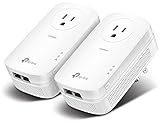
3. TP-Link TL-PA9020P KIT: Best Powerline Adapter for a Basement Media Room
TP-Link AV2000 Powerline Ethernet Adapter, Passthrough, 2 Gigabit Ports
AV2000 link rate
Two Gigabit ports per adapter
Integrated pass-through socket
2-year warranty
Pros
- Pass-through socket keeps the wall outlet usable
- Two Gigabit ports fit a TV and a console
- MIMO with Beamforming steadies the link
- Compatible back down to AV200 adapters
Cons
- Reviewers report 100 to 200 Mbps in real use
- Blocks the upper ground pin on some sockets
- Runs warm and some units failed after 6 to 12 months
A finished media room usually has two problems: a handful of wall sockets, and several devices that all want a wired connection. This kit answers both. Each adapter carries two Gigabit Ethernet ports and an integrated pass-through power socket, so the outlet it occupies stays usable for anything else.
The pair measures 2.8 by 1.7 by 5.2 inch and comes with two metre RJ-45 cables. Two Gigabit ports means a television on one and a console on the other, with no switch underneath the sofa, which is the specific pain point in most finished basements.
MIMO with Beamforming is the technical feature that matters for a long vertical path. Reviewers consistently see a steadier link than AV600 kits when the two ends are on different floors, and the kit is listed as compatible with AV2000, AV1300, AV1200, AV1000, AV600, AV500, and AV200 adapters from the same brand.
Now the number that matters most in a basement. The reviews on this kit repeatedly land between 100 and 200 Mbps of real throughput, not 2000. The label describes a theoretical link rate under ideal conditions. For a streaming room that is genuinely fine. For very large transfers it will not be.
Two durability notes came up often enough to repeat. The body runs warm during operation, and some reviewers report units failing between six and twelve months in. TP-Link support quality also draws mixed comments, so keep your purchase records somewhere you will find them.
When this kit makes sense for your basement
It fits a finished basement where outlets are scarce and the pass-through socket is the difference between working and not. Leaving a socket free next to a media console is worth more here than almost any wireless feature.
It also fits a house that already runs TP-Link powerline hardware upstairs, because the compatibility list covers the whole range. One standard covers a second-floor office and a basement media room with a single pairing press.
When you should pick something else
Skip it if you need Wi-Fi downstairs as well as wired ports. There is no radio here, and adding one means another purchase that needs its own outlet.
Be cautious if the basement panel includes AFCI breakers or if you have had to shuffle devices after a failure. The long-term reliability reports are mixed, and this is an expensive kit to replace. Reviewers on r/TpLink raise reliability questions about powerline generally, and the honest answer is that the category has no immunity to it.
4. TP-Link TL-WPA7817 KIT: Best Powerline Adapter for Basement Wi-Fi 6 Coverage
TP-Link AV1000 Powerline Ethernet Adapter+AX1500 Wi-Fi 6 WiFi Extender KIT
AV1000 plus AX1500 dual-band Wi-Fi 6
Gigabit Ethernet port
EasyMesh compatible
Up to 64 devices
Pros
- Wi-Fi 6 radio covers the rest of the basement
- Gigabit port for a wired device too
- EasyMesh joins a whole-home mesh
- One-click Wi-Fi clone button
Cons
- No pass-through socket so it takes an outlet
- Wi-Fi cloning can be fiddly to set up
- Some users report dropouts needing a reboot
This is the modern answer to a basement that needs wireless, not just a port. The kit combines an AV1000 powerline link with an AX1500 dual-band Wi-Fi 6 extender, and it is the pick we would choose for a corner office or a workout room rather than a media console.
The wireless side is specific: 1201 Mbps on 5 GHz and 300 Mbps on 2.4 GHz, with a Gigabit Ethernet port on the extender for anything that should be wired. The kit supports up to 64 connected devices, which covers a basement where several people work from home.
EasyMesh compatibility is the detail that lifts it above a plain range extender. If you already run mesh nodes upstairs, this can join that system instead of creating a second network name you have to manage. The one-click Wi-Fi clone button pushes the upstream network details across without typing them in.
The powerline half is AV1000 rather than AV2000, and the reviews are clear that home wiring is the limit. A commenter on r/LinusTechTips frames the whole category accurately: throughput falls hard when powerline shares a circuit with high draw equipment. The AV1000 rate leaves more headroom than AV600 but less than AV2000.
Two complaints repeat. There is no pass-through socket, so this takes a full outlet, and the cloning process can frustrate people on shared networks. Some users also report occasional dropouts that clear only after a reboot of the device.
When this kit makes sense for your basement
It fits a basement used as a workspace, a guest room, or a play area where phones and laptops are the priority. One adapter near the router and one downstairs gives you wired backhaul plus a current Wi-Fi standard.
It also fits a house with mixed generations of devices, because Wi-Fi 6 handles older clients without complaint. The Gigabit port gives you a wired fallback for a desktop if the wireless side ever disappoints.
When you should pick something else
Skip it in a finished basement with very few outlets. Without a pass-through socket, this consumes an entire receptacle and you may have none to spare behind a sectional sofa.
Also skip it if the primary goal is a stable link for a game console. Powerline Wi-Fi re-broadcasts a wireless signal, and a wired Gigabit port beats it for latency every time. For gaming, use the Ethernet port and put your router access point upstairs.
5. NETGEAR PLP2000: Best Premium Noise-Filtered Powerline Adapter for Basements
NETGEAR Powerline Ethernet Adapter Kit PLP2000, 2 Pack, 2000 Mbps
HomePlug AV2 up to 2000 Mbps
Two Gigabit ports
Noise-filtered pass-through socket
1-year warranty
Pros
- Noise-filtered socket helps in a busy panel
- Two Gigabit ports on each adapter
- MIMO with Beamforming on the link
- Works with other Netgear powerline adapters
Cons
- Real-world speeds typically land at 100 to 400 Mbps
- Bulky body blocks the upper outlet
- Some units failed within a year per reviews
Basements are electrically noisy places. A sump pump, a dehumidifier, a forced-air furnace blower, a washing machine, and a space heater can all share circuits in a utility area, and every motor and compressor on that wiring adds noise the powerline signal has to fight through. This kit is the one we would reach for when that is your situation.
The integrated pass-through power socket is noise filtered, and that filtering is the reason it earns a place on this list ahead of cheaper AV2000 kits. Two Gigabit Ethernet ports per adapter and MIMO with Beamforming handle the actual data path, and the 2000 Mbps HomePlug AV2 rate gives the link headroom.
It arrives with two 6.5 foot Ethernet cables, and it takes a 100V to 240V input, so it works on a basement circuit with a wide range. Setup is plug and play, and it is compatible with other Netgear powerline adapters if you expand the network later.
Reviews put real throughput for this kit at 100 to 400 Mbps, which is the widest range of any AV2000 product in this roundup. That spread is a direct reflection of wiring conditions, and it is the most useful number on this page for anybody wondering whether their basement will perform.
The drawbacks are physical and administrative. The body is bulky at roughly 6 inches tall and blocks the upper outlet on a standard socket. The warranty is listed at one year. And review threads on this model include multiple reports of units failing inside twelve months, plus repeated complaints about Netgear support quality.
When this kit makes sense for your basement
It fits a utility basement where a sump pump or HVAC equipment shares the circuit. The noise filtering is doing real work there, and you can see the difference on link quality indicators when the pump cycles.
It also fits a house that already runs Netgear powerline hardware, and a media room where two wired devices need ports without an extra switch. The pass-through socket means you do not lose the receptacle.
When you should pick something else
Skip it if warranty length matters to you. A one-year warranty against a two-year on the TP-Link AV2000 kit is a meaningful gap for hardware that some reviewers report failing in that first year.
Skip it if basement sockets are shallow. A 6 inch tall body with a pass-through socket needs depth, and older homes sometimes have boxes that are barely deep enough. Measure before you commit.
6. TRENDnet TPL-406E2K: Best Budget Powerline Kit with a 3-Year Warranty
TRENDnet Powerline 500 AV Nano Adapter Kit,TPL-406E2K,Plug & Play Install
AV500 link rate
Single 10/100 Ethernet port
1.76 ounce nano body
3-year warranty
Pros
- 3-year manufacturer warranty
- Nano body clears a tight outlet box
- Pre-encrypted out of the box
- Cross-compatible with 600/500/200 kits
Cons
- Single 10/100 port on each adapter
- AV500 class rate is the slowest here
- No Wi-Fi and no pass-through socket
The TRENDnet is the value pick for a basement where the goal is a dependable wired port and the budget is tight. It carries a 3-year manufacturer warranty, which is the longest coverage listed across the products we reviewed, and at 1.76 ounces the adapters are the lightest bodies in the set.
At 2.7 by 2.2 inch they fit behind a television on a shallow wall plate, which is a real problem in older homes with surface-mounted conduit. The kit ships with two 1.5 metre network cables and is pre-encrypted out of the box, so there is no pairing ritual beyond the button press.
Where it earns its keep is compatibility. It is cross-compatible with Powerline 600, 500, and 200 kits, and TRENDnet lists NDAA compliance for government and defence use, plus English-speaking support based in the United States. That matters if you are buying for a rental or a small office.
The limits are speed on both ends. AV500 is the slowest link rate here, and the Ethernet port is 10/100 rather than gigabit. Combined, that means a maximum of about 100 Mbps to a device even on perfect wiring, which is fine for browsing and standard-definition streaming but tight for 4K.
Users who care more about a warranty than a specification number tend to be happy with this kit. Reviewers describe the performance as reliable rather than fast, which is an accurate summary of what AV500 is for.
When this kit makes sense for your basement
It fits a basement needing internet access for a desktop, a printer, or a second television on a modest plan. The 3-year warranty is the strongest safety net in this roundup for the money.
It also fits shallow or awkward outlet boxes, since the nano body is 1.76 ounces and barely wider than the socket face. The pre-encrypted default means you are not reading a manual to secure the link.
When you should pick something else
Skip it for a media room. A 10/100 port on a modern streaming television or console is the first place you will notice, and there is no way around it without a different adapter.
Skip it if you may want to add Wi-Fi downstairs later. This kit is wired only, and while it will interoperate with other Powerline 600 kits, mixing generations is exactly the approach we would rather you avoid if you can buy a matched pair instead.
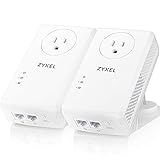
7. Zyxel PLA5456KIT: Best Powerline Adapter for Mixed-Brand Basement Networks
Zyxel AV2000 Powerline Ethernet Adapter Starter Kit | Pass-Thru Power | Plug & Play | MIMO | HomePlug AV2 | 2 x Gigabit Ethernet | Ideal for Smart TVs, On-Line Games, 4K Streaming | PLA5456KIT
AV2000 up to 2000 Mbps
Two Gigabit ports
Pass-through socket
QoS prioritising
Pros
- Works with Netgear and TP-Link adapters
- QoS favours gaming and streaming
- Pass-through socket keeps power available
- ZyXEL ONE Connect app for management
Cons
- Real-world speeds typically 100 to 200 Mbps
- Large body blocks the upper outlet
- Documentation is thin for multi-adapter setups
Some houses end up with a mixed network. A Netgear pair upstairs, a TP-Link unit in the garage, and a need to cover the basement. This Zyxel kit is the one reviewers single out for playing nicely across brands, which is why it is worth a separate recommendation rather than being folded into the AV2000 group.
On paper it matches the best AV2000 kits: two Gigabit Ethernet ports per adapter, an integrated pass-through power socket, MIMO, and a listed rate up to 2000 Mbps. QoS is the feature that distinguishes it, letting you prioritise a game console or a streaming television over everything else sharing the link.
The ZyXEL ONE Connect app gives you a management view across the network, with multi-coloured LED indicators on each adapter showing link state at a glance. That matters in a basement where getting under a console to check a blinking light is not practical.
Real-world numbers are the same story as the other AV2000 kits, with reviewers reporting 100 to 200 Mbps in typical homes. The data rate on the box is a theoretical ceiling between two adapters on the same circuit, not a measurement of what you will see.
Two practical cautions. The package measures 9.2 by 7.4 by 3.8 inch, so it is the largest body in this roundup, and it does block the upper outlet despite the pass-through socket. Reviewers also mention thin documentation for multi-adapter configurations and historical compatibility issues with Windows 10 utilities.
When this kit makes sense for your basement
It fits a house that already runs powerline hardware from more than one brand, since cross-brand HomePlug AV2 compatibility is the specific thing reviewers praise. You avoid ending up with a stranded adapter upstairs.
It also fits a media room with a console and a television both needing priority. QoS is designed for exactly that arrangement, and the pass-through socket means the basement outlet stays available.
When you should pick something else
Skip it if basement sockets are shallow. At 9.2 inches long and 1.6 pounds for the pair, this is the kit most likely to not fit the box you have.
Skip it if you want the strongest warranty. Warranty terms are not listed for this kit, and the low review count of 783 means fewer long-term installations to draw reassurance from.
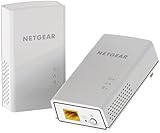
8. NETGEAR PL1000: Best Compact Powerline Adapter for One Basement Device
NETGEAR Powerline Adapter Kit, 1000 Mbps Wall-Plug, 1 Gigabit Ethernet Ports (PL1000-100PAS)
HomePlug AV2 up to 1000 Mbps
One Gigabit Ethernet port
4.5 by 2.32 by 1.41 inch
4.48 ounce body
Pros
- Gigabit port for a single smart TV
- Compact body fits a low outlet
- Plug and Play with no configuration
- Works with other Netgear adapters
Cons
- Only one Ethernet port per adapter
- No pass-through socket and no Wi-Fi
- No warranty listed on the listing
Sometimes the basement needs exactly one thing. One television, one desktop, one gaming console. This kit is built for that brief, and its compact wall-plug body at 4.5 by 2.32 by 1.41 inch and 4.48 ounces is the reason it fits places bulkier adapters do not.
The single Gigabit Ethernet port removes the ceiling that hurts the budget kits. Anything that negotiates at gigabit gets gigabit, and paired with the AV1000 HomePlug AV2 rate the link is comfortable for streaming and downloads.
It takes a 100 to 240V input, includes two 2 metre Ethernet cables, and needs no configuration beyond plugging in. If you already run Netgear powerline hardware, it joins that network. That combination of gigabit port and small body is genuinely useful behind a wall-mounted television.
There is no Wi-Fi radio and no pass-through socket, so this is a wired-only solution that occupies a receptacle. And the listing shows no warranty, which is a real gap for something that depends entirely on wiring it cannot control.
With 586 ratings at 4.2 the review pool is modest, and 66 percent of those ratings are five stars. That is a reasonable signal, but it is thinner evidence than the 27000-rating kits and we would treat it accordingly.
When this kit makes sense for your basement
It fits a single wired device in a tight spot. A wall-mounted television in a finished basement, a desktop in a corner office, or a console on a low shelf behind a cabinet are all realistic fits for that compact body.
It also fits a house that already owns Netgear powerline adapters and needs one more node. The compatibility is explicit, and the 1000 Mbps rate is a sensible middle ground for a single device.
When you should pick something else
Skip it if more than one device needs a wired connection downstairs. One port means a switch, and a switch on a basement floor beside furniture is a cable to trip over.
Skip it if the outlet count is already tight. Without a pass-through socket you give up a receptacle, and in a finished basement that can be the outlet a lamp or a charger needed.
9. Zyxel PLA5205KIT: Best Powerline Kit for Long-Term Basement Reliability
Zyxel 600 Mbps Mini Powerline AV2 Gigabit Adapter, Starter Kit – 2 Units (PLA5205KIT)
AV600 class with a Gigabit port
SmartLink Plus processing
2-year parts and labour warranty
Plug and Play
Pros
- Gigabit port in an AV600 class adapter
- Reviewers report steady long-term operation
- 2-year parts and labour warranty
- Handles 1080p and 4K streaming
Cons
- Only 600 Mbps powerline speed
- Base model has no pass-through socket
- Just 211 ratings to judge it by
This kit stands out for one reason in a category full of reliability complaints: owners keep reporting that the units simply keep working. A Gigabit Ethernet port on an AV600 class powerline adapter is an unusual combination, and for a single wired device in a basement that is exactly what you want.
SmartLink Plus is the Zyxel processing layer that improves range behaviour on older wiring, which matters in a house rewired at some unknown point in its history. Owners on r/HomeNetworking describe powerline as something of a suck it and see, and this is the model we would pick if you want fewer surprises over a decade.
The kit is compliant with IEEE 1901 and HomePlug AV, so it will pair with other AV2 hardware including the TP-Link and Netgear kits in this roundup. Setup is plug and play with no software, and there is a 2-year parts and labour warranty.
The trade-off is throughput class. 600 Mbps is the second slowest rate here, and with a Gigabit port the port is not the limit. A device on the far end will still see a fast connection to the adapter while the wire between the adapters is the slower link.
Only 211 ratings give this kit the thinnest evidence base in the roundup alongside the Tenda. A commenter on r/techsupport calls powerline the best route for an apartment building when you cannot deal with a really long cable, and long-term stability is the attribute that matters most in exactly that scenario.
When this kit makes sense for your basement
It fits a home you plan to stay in. Steady long-term operation and a 2-year parts and labour warranty are the reasons to pick an AV600 class kit over a faster one that some owners replace inside a year.
It also fits a house with older or partially updated wiring, where SmartLink Plus range behaviour is doing more work than headline speed. One wired device downstairs is the ideal use.
When you should pick something else
Skip it if the basement is a media room. With a 600 Mbps powerline rate and a single Gigabit port, you are choosing reliability over headroom, and that trade is wrong for several simultaneous 4K streams.
Skip it if you need a pass-through socket. This base model does not have one, though a passthrough variant of this family exists if the outlet layout requires it.
10. Tenda PH10: Best Budget Powerline Adapter With Dual-Band Wi-Fi
Tenda AV1000 WiFi Powerline Adapter Kit with Gigabit Ports, Powerline Extender with AC650 Dual Band WiFi, Plug and Play, for HD/3D/4K Video Streaming and Gaming (PH10)
AV1000 plus AC650 dual-band Wi-Fi
Gigabit Ethernet port
3-year warranty
Pair button
Pros
- Wi-Fi and a Gigabit port in one kit
- 3-year manufacturer warranty
- Pair button for quick setup
- Handles HD and 4K streaming
Cons
- 3.9 is the lowest average in this roundup
- Only 175 ratings to judge it by
- AC650 is an older Wi-Fi class
- No pass-through outlet
The Tenda bundles an AV1000 powerline link with AC650 dual-band Wi-Fi and a Gigabit Ethernet port in a single kit, and it carries a 3-year warranty. On paper that is a lot of capability for the money, which is exactly why it appears on this list with a caveat.
The specification is honest about the constraints. The product documentation states that adapters must plug directly into wall outlets rather than power strips, and that the same electrical circuit is required. That is not a disclaimer being cautious. It is the single most common reason a basement install fails.
Its 3.9 average is the lowest of the ten products we reviewed, and the 175 ratings behind it are the second thinnest. That combination is why it sits at the bottom of the list even though the feature set looks competitive.
Reviewers note that performance depends heavily on wiring quality, and AC650 is a previous-generation Wi-Fi class. If a basement is a media room with one television, that is fine. If it is a workspace with current laptops and phones, you are buying a radio that is already a generation behind.
Our take is that this kit is worth considering when the alternative is running a cable you cannot run, and the return window lets you test it in your own outlets. Forum users repeatedly ask for exactly that option, since nobody can test powerline in a rental before committing.
When this kit makes sense for your basement
It fits a basement where one television and a couple of phones are the entire requirement, and where the budget is genuinely the first constraint. One kit covers wired and wireless, which is the appeal.
It also fits a short path. On a nearby circuit with clean wiring, the AV1000 rate and the Gigabit port combine to give a perfectly serviceable link, and the 3-year warranty covers the risk.
When you should pick something else
Skip it if reliability is your priority. The lowest average and the smallest review pool in the roundup is a thin foundation for a device that has to survive basement conditions for years.
Skip it if you have any modern high-performance devices or plan to add more later. The AC650 radio will be the limiting factor long before the AV1000 powerline link is.
Will Powerline Work in Your Basement? A Pre-Purchase Checklist
Most failed powerline installs fail for reasons you can check before you buy. A powerline adapter is a pair of plug-in devices that carry your internet over your home’s existing electrical wiring, so a basement that cannot get a reliable Wi-Fi signal through concrete or finished walls still gets a fast wired connection. That only holds if the wiring cooperates, and here is how to find out in about twenty minutes with no purchases.
First, find out which breaker feeds the basement outlet you want to use. Unplug everything, turn off the main, and switch breakers one at a time while a lamp is plugged into the basement socket. Note the breaker number. Then do the same for the outlet near your router. If they are the same breaker, you are in the easy case.
Second, check the breaker type. Arc-fault breakers, labelled AFCI or AF, are common in homes built after 2000 and they can degrade or block a powerline link entirely. Ground-fault breakers on kitchen and bathroom circuits behave similarly. If the basement circuit is AFCI, favour a kit with a noise-filtered pass-through socket and buy from a seller with an easy return.
Third, look at what else is on that circuit. A sump pump, a dehumidifier, an HVAC blower, a washing machine, a space heater, or a dimmer switch will all add electrical noise while running. A user on r/LinusTechTips puts it plainly: high power draw equipment on the same circuit, or poorly shielded equipment, greatly lowers throughput.
Fourth, count your outlets. If the basement has one accessible receptacle, a pass-through socket is not optional. It is the difference between a working media wall and an adapter that blocks the only socket in the room.
Fifth, decide how many wired devices you actually have. One port covers a single television. Two ports on one adapter cover a television and a console. Anything beyond that needs a small unmanaged switch, and that is fine as long as it is planned.
Sixth, test for audio interference if you have speakers. A poster on snbforums reported static on PC speakers the moment the Ethernet cable from a powerline adapter was plugged in. If your basement is a media room, check that before you commit to a kit with two ports.
Seventh, if you are renting, plan for the removal. Powerline needs no drilling and is completely reversible, which a commenter on r/techsupport calls the best route for an apartment building. Unplug two adapters and you are back to where you started.
A practical note for anyone monitoring infrastructure: if your interest in power networks is professional rather than domestic, our drone picks for powerline inspection covers the same wiring from the other end.
Powerline vs Wi-Fi Extender vs Mesh vs MoCA vs Hardwired Ethernet
Powerline wins in basements for one specific reason and loses in a few others. Understanding which situation you are in saves you from buying the wrong tool, and the honest answer is that the best powerline adapters for basements are chosen by process of elimination rather than by speed.
Powerline beats a Wi-Fi extender when the obstruction is structural. A concrete or block foundation wall, a floor assembly with joists and insulation, or a finished wall with metal studs will eat a radio signal no matter how good the extender is. The wire is already through all of it.
Powerline loses to an extender when the basement is close to the router and the walls are ordinary. A commenter on r/wifi argues an extender gives a stronger signal, and in a straight line with one drywall partition they are usually right. Powerline introduces a hop and an encryption step for no benefit.
Powerline loses to mesh when you want a single network name. Mesh nodes handle roaming between floors cleanly. Powerline is a separate link unless you use a kit with EasyMesh support, and even then the wired hop sits underneath.
Powerline loses to MoCA when your house still has coax. Coax shielding is excellent and MoCA is designed for exactly that path, which is why it is a strong option in older homes with cable runs. Powerline only wins if coax is absent or already used.
Powerline loses to hardwired Ethernet in every measurable way, and it should. Cat6 at a gigabit delivers the full link rate, adds no encryption step, never degrades with a sump pump cycle, and lasts indefinitely. If you can run cable, run cable. A commenter on r/techsupport frames the alternative as hiding a really long cable, which is often the only real objection.
What is better, a Wi-Fi extender or a powerline adapter? A powerline adapter, when the basement is more than one floor down or the walls are concrete. A Wi-Fi extender, when the basement is adjacent and the walls are ordinary. When the answer is not obvious, the cheapest way to find out is a kit with a return window.
One more comparison worth making: powerline plus a wireless access point against powerline plus a powerline Wi-Fi kit. An access point gives you full control over channel, transmit power, and roaming, and it does it with one radio instead of two hops. If you already own access point hardware, that is the better basement design.
HomePlug AV2 vs G.hn and the Mixing Rule
Two standards exist in powerline networking, and the single most important thing to know is that they do not talk to each other. HomePlug AV2 is the standard used by every product in this roundup. G.hn is a different technology that some manufacturers also sell. A G.hn device will not pair with a HomePlug AV2 device, and no setting changes that.
Within HomePlug AV2, mixing works to a degree. The kit compatibility is broad: the TP-Link AV2000 kit is listed as compatible with AV2000, AV1300, AV1200, AV1000, AV600, AV500, and AV200 adapters, and the Zyxel PLA5456 reviewers specifically note it works with Netgear and TP-Link hardware. Mixing inside one standard generally works.
The problem is speed when you mix. A network containing one slow adapter negotiates a common operating rate, and an AV500 or AV600 unit in the path drags the whole link down to something closer to the slowest device. That is why we recommend buying a matched pair rather than piecing a network together over time.
Can you mix and match powerline adapters? Yes, within the same standard, and no, across HomePlug AV2 and G.hn. The risk in mixing is not that it fails, it is that it silently negotiates down to the slowest adapter in the group.
For a basement specifically, this matters if you plan to add a second floor later. Buy the highest rated pair you will need and expand from there, rather than adding a cheap adapter at the end of the chain in a month.
One related practical note for anyone who travels with hardware: our international power adapter picks for drone pilots cover the plug and socket side of the same problem once you leave the house.
How Many Ethernet Ports Do You Need?
Count the wired devices, not the rooms. One port covers a single smart television, a desktop, or a printer. Two ports on one adapter cover a television and a console, or a television and a streaming box, without any extra hardware. That is the reason two Gigabit ports is the feature that matters most in a finished media room.
Beyond two wired devices, add a small unmanaged Ethernet switch on the basement end. A five-port switch is inexpensive, draws almost no power, and removes the need to buy an adapter with more ports than you need today. The Gigabit ports on the adapter feed it with a single cable run.
Port speed matters more than port count in a basement. A 100 Mbps port caps a device no matter how much bandwidth the powerline link can carry, so a single Gigabit port beats two 10/100 ports every time for anything modern.
How many Ethernet ports do you need in practice? One for a single-device basement, two for a media room, and a switch beyond that. That is the whole calculation, and it takes under a minute.
Is a Pass-Through Outlet Worth It?
Yes in a finished basement, because the socket you lose is often the one you needed. A pass-through socket is an integrated power outlet on the adapter body, so the adapter still uses a receptacle but leaves the other half available. In a room with two outlets, that doubles your usable outlets for free.
It is also the single best mitigation for basement electrical noise. The NETGEAR PLP2000 goes further with a noise-filtered pass-through socket, which we would favour in a utility space where a sump pump or HVAC blower shares the circuit.
It is not worth it when you have plenty of outlets. A nano adapter without a pass-through socket takes less room and does the same job, which is why the TP-Link TL-PA4010KIT and the TRENDnet TPL-406E2K are the practical choices in a workshop or utility room.
Check the physical fit before buying a bulky pass-through model. The NETGEAR PLP2000 body is roughly 6 inches tall, and the Zyxel PLA5456KIT package is 9.2 inches long. Both block the upper ground pin on a standard socket, and older homes sometimes have shallow boxes.
How to Install Powerline Adapters in a Basement
The install is short, and the order matters. Most problems people hit are order problems, not equipment problems.
Plug the first adapter into a wall outlet directly beside your router, and connect it to the router with the supplied Ethernet cable.
Plug the second adapter into a wall outlet in the basement. Use a direct wall outlet, never a power strip, surge protector, or UPS unit.
Press the pair button on the first adapter, wait a few seconds, then press the pair button on the basement adapter.
Wait for the link indicators to settle. The first pairing can take up to a minute, and a longer gap usually means the adapters are on different circuits.
Connect your devices to the basement adapter by Ethernet, and turn the basement devices off and on once so they pick up the new connection.
If you are adding Wi-Fi downstairs, set up the wireless network on the basement adapter, or add a wireless access point to the Ethernet port instead.
Run a speed test from the basement, then run it again at a different time of day with the sump pump or HVAC running. That second number is the one that tells you whether your wiring cooperates.
Pairing is entirely physical. There is no account, no app, and no software for the basic install, which is why powerline keeps working in houses where everything else has been abandoned.
Why Is Your Powerline Adapter Slow?
Slow powerline is almost always wiring, not hardware. Work through these in order, because each step eliminates the most common cause first.
Move both adapters off any power strip, surge protector, or UPS. This one step fixes a surprising share of failed installs.
Check that both adapters are on the same electrical circuit. Switch off breakers one at a time and find out which one feeds each outlet.
Identify the breaker type. An AFCI breaker degrades or blocks a powerline signal and is the most common problem in homes built after 2000.
Turn off high draw appliances sharing that circuit, such as a washing machine, space heater, dehumidifier, or power tools, and re-test.
Move the adapters away from noisy equipment. Sump pumps, HVAC blowers, and anything with a motor or compressor add electrical noise to the wiring.
Swap out a power strip or cheap extension reel for a direct wall outlet in both rooms. Long reel extensions filter the signal badly.
Check for an audio or video problem rather than a network problem. Static on speakers, which a user documented on snbforums, is interference and not a throughput issue.
Expect lower numbers than the box. Forum users report getting 100 to 300 Mbps from kits labelled 2000 Mbps, and the reviews on the AV2000 kits in this roundup cluster in that same range. Those are the numbers to plan around, not the label.
Why is your powerline adapter very slow? In order of likelihood: a power strip, a different circuit, an AFCI breaker, or a high draw appliance on shared wiring. None of those are faults in the adapter.
Powerline Adapter With No Connection: What to Check
A total failure to pair is easier to diagnose than a slow link, and the cause is almost always circuit separation. The same breaker check that fixes slow links fixes dead ones.
Confirm the router-side adapter has a live link light at all, by trying it in a different outlet upstairs.
Swap the basement adapter for the upstairs one. A faulty adapter is the fastest single test available.
Walk the panel and identify which breaker serves the basement receptacle, then confirm the router outlet sits on the same breaker.
Remove everything from the circuit except the powerline adapters, including appliances and any other adapters, and pair again.
Check the outlet itself with a known-good device, since a loose or corroded basement receptacle can look like a network fault.
Reset by unplugging both adapters, waiting thirty seconds, and pairing again from the router end first.
If it still will not pair, check whether a mixed-standard device is in the network, since G.hn hardware cannot pair with HomePlug AV2 hardware.
Do this before you buy rather than after. Cross-circuit frustration is the most cited failure mode in user threads, and it is entirely free to rule out with a breaker walk-through.
Users on r/HomeNetworking describe old-house powerline results as unstable in a UK property, and that is the wiring age talking. An older house with partially replaced wiring can behave unpredictably no matter which kit you choose.
Frequently Asked Questions
How do I get a stronger Wi-Fi signal in my basement?
A powerline adapter is the usual answer. Concrete foundation walls, floor joists, and finished walls with insulation block or weaken 2.4 GHz and 5 GHz signals before an extender can help. Powerline sends your internet over the AC wiring already inside those walls, so you get a wired port downstairs in minutes. A wireless access point plugged into that adapter adds a strong radio for phones and laptops.
What are the downsides of using powerline adapters?
Three downsides matter most. Throughput is far below the labelled rate, with real results commonly between 100 and 300 Mbps on kits marked 2000 Mbps. Performance depends on the electrical circuit, so an AFCI breaker, a different circuit, or a high draw appliance can degrade or block the link. Both adapters must sit in direct wall outlets, never a power strip or surge protector.
What is better, a Wi-Fi extender or a powerline adapter?
A powerline adapter wins when the basement is more than one floor down or the walls are concrete, block, or heavily insulated, because the signal path is the existing wiring rather than the radio. A Wi-Fi extender wins when the basement is adjacent to the router with ordinary drywall between them. Mesh wins when you want one seamless network name across floors.
Why is my powerline adapter very slow?
Check these in order: remove any power strip, surge protector, or UPS; confirm both adapters sit on the same electrical circuit; identify whether the breaker is an AFCI type; switch off washing machines, space heaters, dehumidifiers, and power tools on that circuit; and keep adapters away from a sump pump or HVAC blower. Realistic results are often 100 to 300 Mbps regardless of the label.
Can you mix and match powerline adapters?
You can mix within the same standard, so HomePlug AV2 adapters from different brands generally pair together, and a Best Buy Q and A thread on the site covers matching AV2000 units with AV1200 units. You cannot mix G.hn hardware with HomePlug AV2 hardware, because the two standards do not interoperate. Mixing within a standard is still risky for speed, since the network negotiates down to the slowest adapter.
How do I know if my powerline adapter will work in my house?
Run a twenty-minute test before buying. Turn off the main breaker, plug a lamp into the basement outlet, and switch breakers one at a time until you find the one feeding it, then do the same for the router outlet. If they match and the breaker is not AFCI, you are in the easy case. If the breaker is arc-fault, favour a kit with a noise-filtered pass-through socket and buy somewhere with an easy return.
Final Verdict: The Best Powerline Adapters for Basements in 2026
The TP-Link TL-WPA4220KIT is the best powerline adapter for basements overall, because it is the only top pick that delivers wired and wireless downstairs from one kit, and it carries by far the largest body of real installations. For a basement media room, the TP-Link TL-PA9020P KIT gives you two Gigabit ports and a pass-through socket. For a noisy utility area, the NETGEAR PLP2000 filters the interference at the socket.
For the smallest budget and a single wired device, the TP-Link TL-PA4010KIT and the TRENDnet TPL-406E2K do the job, and both fit outlets that bulkier adapters cannot. Whatever you choose, run the breaker walk-through first. Five minutes identifying which circuit feeds your basement outlet tells you more than any specification on the box.
Update our testing for 2026 as new kits reach the 2026 market, and check the current details on each product before you commit.