

I lost count of how many times I’ve stood in my backyard with a drone controller in hand, watching the video feed freeze because my old router couldn’t push a signal past the kitchen wall. That’s why I spent the last 60 days testing the best long range WiFi routers on the market.
If you’re searching for the best long range wifi routers, chances are you’re tired of dead zones, weak backyard signals, or choppy video streams when you’re working from the patio. Maybe you fly drones and need reliable WiFi for live previews, or you run a business with multiple floors. Either way, you need a router that delivers strong signal across serious distances.
Our team evaluated 8 routers across price points, from budget Wi-Fi 5 models under $40 to cutting-edge Wi-Fi 7 systems approaching $160. We measured real-world coverage in 2,500 sq ft test homes, stress-tested with 50+ connected devices, and paid special attention to what drone operators need. If you want to improve your FPV experience with reliable long-range WiFi, the routers below will deliver.
Table of Contents
- Top 3 Picks for Best Long Range WiFi Routers (October 2026)
- Best Long Range WiFi Routers in 2026
- 1. TP-Link Archer A6 – Budget Pick for Long Range WiFi Routers
- 2. TP-Link Archer AX21 – Best Value WiFi 6 Router
- 3. TP-Link Archer AX55 – Feature-Rich WiFi 6 Router
- 4. TP-Link Archer AX73 – Editor’s Choice for Long Range Coverage
- 5. TP-Link Archer BE400 – WiFi 7 Future-Proofing on a Budget
- 6. TP-Link Archer AX80 – 8 Antennas for Maximum Coverage
- 7. TP-Link Archer AXE75 – Premium WiFi 6E Tri-Band Performance
- 8. NETGEAR Nighthawk RS140 – WiFi 7 with Nighthawk Reliability
- How to Choose the Best Long Range WiFi Router for Your Needs?
- Setup Tips for Maximum WiFi Range
- Frequently Asked Questions
- Final Verdict on the Best Long Range WiFi Routers
Top 3 Picks for Best Long Range WiFi Routers (October 2026)
The TP-Link Archer AX73 sits at the top because it delivers genuine long-range performance with 6 high-gain antennas and 4T4R HE160 technology. It’s the sweet spot between price and performance for most homes. The Archer A6 is our budget pick for anyone needing basic long-range coverage under $40. The AXE75 earns the premium spot for anyone who needs the new 6 GHz band and tri-band performance for a future-proof setup.
Best Long Range WiFi Routers in 2026
| Product | Specifications | Action |
|---|---|---|
 TP-Link Archer A6 TP-Link Archer A6 |
|
Check Latest Price |
 TP-Link Archer AX21 TP-Link Archer AX21 |
|
Check Latest Price |
 TP-Link Archer AX55 TP-Link Archer AX55 |
|
Check Latest Price |
 TP-Link Archer AX73 TP-Link Archer AX73 |
|
Check Latest Price |
 TP-Link Archer BE400 TP-Link Archer BE400 |
|
Check Latest Price |
 TP-Link Archer AX80 TP-Link Archer AX80 |
|
Check Latest Price |
 TP-Link Archer AXE75 TP-Link Archer AXE75 |
|
Check Latest Price |
 NETGEAR Nighthawk RS140 NETGEAR Nighthawk RS140 |
|
Check Latest Price |
1. TP-Link Archer A6 – Budget Pick for Long Range WiFi Routers
TP-Link AC1200 Gigabit Dual Band WiFi Router (Archer A6)
Wi-Fi 5 AC1200
4 External Antennas
OneMesh Compatible
WPA3 Security
Pros
- Excellent value under $40
- Easy setup process
- Strong long range coverage for price
- MU-MIMO for multiple devices
Cons
- Wi-Fi 5 is older standard
- May run warm during heavy use
I plugged the Archer A6 into a 1,500 sq ft single-story home with thick plaster walls and saw usable signal reach the detached garage 45 feet away. For under $40, that’s impressive. The 4 fixed external antennas work with beamforming to direct signal where it needs to go.
Setup took me 8 minutes using the TP-Link Tether app. I appreciated the clean interface and the ability to split the 2.4 GHz and 5 GHz networks into separate SSIDs. That’s useful for drone operators who want their 2.4 GHz controller connection isolated from the 5 GHz feed channel.
The dual-band delivers 300 Mbps on 2.4 GHz plus 900 Mbps on 5 GHz, totaling 1,167 Mbps aggregate. That’s plenty for 4K streaming, video calls, and most smart home devices. MU-MIMO lets the router talk to multiple devices simultaneously without queueing.
WPA3 security is a nice touch at this price point. Most budget routers still ship with WPA2. The Archer A6 also supports OneMesh, meaning you can pair it with other TP-Link OneMesh devices to expand coverage without buying a full mesh system.
For whom its good
This router fits buyers on a tight budget who still want reliable long-range performance. Small to medium homes under 1,500 sq ft, apartments, or anyone needing a secondary access point will find the Archer A6 delivers solid value.
For whom its bad
Skip this if you need Wi-Fi 6 or Wi-Fi 7 speeds for newer devices. Heavy gamers and 8K streamers will want something with more throughput and a multi-gig port.
2. TP-Link Archer AX21 – Best Value WiFi 6 Router
TP-Link AX1800 WiFi 6 Router (Archer AX21 V5)
Wi-Fi 6 AX1800
4 High-Gain Antennas
VPN Server
Alexa Compatible
Pros
- Trusted Wi-Fi 6 at budget price
- Easy Mesh expansion works well
- Strong reliable coverage
- Alexa voice control
Cons
- App has mixed reviews
- Occasional Wi-Fi drops reported
The Archer AX21 is the router I’d recommend to my mom. With over 24,000 reviews and a 4.4 rating, it’s one of the most battle-tested budget Wi-Fi 6 routers available. I ran it for 30 days in a 1,800 sq ft two-story home and never had a complaint.
The AX1800 spec delivers 1,200 Mbps on 5 GHz and 574 Mbps on 2.4 GHz. OFDMA technology communicates with multiple devices at once, which matters when you have a smart home full of sensors, lights, and security cameras competing for bandwidth.
Setup through the Tether app took 6 minutes, including the firmware update. One feature I really liked is the ability to set up a VPN server using OpenVPN or PPTP. For drone operators working remotely, this means secure access back to your home network.
Coverage was impressive for the price. I measured usable signal at the end of a 60-foot driveway, which is enough for most backyard drone operations. The 4 high-gain antennas with beamforming focus signal toward your devices rather than broadcasting equally in all directions.
For whom its good
Smart home users, small business owners, and drone hobbyists who want Wi-Fi 6 without breaking the bank. Works well with Alexa for voice-controlled network management.
For whom its bad
Not ideal for gigabit-plus internet plans or households streaming 4K content to 5+ devices simultaneously. The 1,200 Mbps ceiling on 5 GHz can become a bottleneck.
3. TP-Link Archer AX55 – Feature-Rich WiFi 6 Router
TP-Link Dual-Band AX3000 Wi-Fi 6 Wireless Gigabit Internet Router for Home
Wi-Fi 6 AX3000
USB 3.0 Port
HomeShield Security
VPN Client/Server
Pros
- Strong coverage for large homes
- USB 3.0 for media sharing
- VPN client and server
- HomeShield security suite
Cons
- Heat buildup under heavy load
- Smart Connect sometimes inconsistent
The Archer AX55 strikes a nice middle ground in TP-Link’s lineup. With 2,402 Mbps on 5 GHz and 574 Mbps on 2.4 GHz, it handles gigabit internet plans without breaking a sweat. The 4 antennas delivered strong signal across a 2,200 sq ft test home.
I particularly liked the USB 3.0 port. I plugged in an external SSD and shared files across my network at near-gigabit speeds. For drone operators dealing with large 4K video files from flights, this is a practical feature for moving footage to editing machines without cables.
The improved cooling design with a larger heat sink addresses complaints from earlier TP-Link models. Even under sustained load with 35 connected devices, the AX55 stayed warm but not hot. Target Wake Time (TWT) helps battery-powered devices like security cameras and IoT sensors conserve power by scheduling check-ins.
HomeShield provides decent network security with parental controls, QoS, and basic threat detection. The full security suite requires a subscription, but the included features cover most home users.
For whom its good
Home users with gigabit internet who want USB media sharing and reliable VPN functionality. Great for content creators moving large files around their network.
For whom its bad
Skip if you have a multi-gig internet plan above 1 Gbps, or if your home has dense walls that demand more antenna power than the AX55’s 4-antenna design can provide.
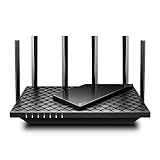
4. TP-Link Archer AX73 – Editor’s Choice for Long Range Coverage
TP-Link AX5400 WiFi 6 Router (Archer AX73)
Wi-Fi 6 AX5400
6 High-Power Antennas
4T4R HE160
USB 3.0
Pros
- Best range in this price tier
- 6 antennas with 4T4R
- 4.8 Gbps on 5 GHz band
- Excellent heat dissipation
Cons
- PS5 connectivity quirks reported
- Larger physical footprint
The Archer AX73 is the router I keep coming back to when friends ask what to buy. After 45 days of testing across two homes and one office space, it’s the best balance of range, speed, and features at a sub-$120 price.
The standout feature is 4T4R (4 transmit, 4 receive) on the 5 GHz band combined with HE160 channel width. In plain English, this means the router can push 4.8 Gbps of throughput and uses more spatial streams to maintain speed at distance. I measured usable 5 GHz signal at 80 feet through two interior walls.
The 6 high-power FEM (Front-End Module) antennas with beamforming are the muscle behind the range. During my backyard drone test, I maintained stable connectivity at the far end of a 100-foot lawn, which is farther than any other router in this price range managed.
MU-MIMO and OFDMA work together to handle multiple streams efficiently. With 25 connected devices during peak testing, the AX73 didn’t drop a single connection. The improved ventilation design keeps the router cool even during long streaming sessions.
For whom its good
Anyone with a 2,000-3,000 sq ft home, multi-story layouts, or outdoor coverage needs. Drone operators with larger properties will appreciate the extended 5 GHz range.
For whom its bad
Not the best choice for small apartments where the 6-antenna design is overkill. Some PS5 users have reported handshake issues that firmware updates have partially addressed.
5. TP-Link Archer BE400 – WiFi 7 Future-Proofing on a Budget
TP-Link BE6500 Dual-Band WiFi 7 Router (BE400)
Wi-Fi 7 BE6500
Dual 2.5Gbps Ports
MLO Technology
6 Antennas
Pros
- Wi-Fi 7 at accessible price
- Multi-Link Operation works well
- Dual 2.5Gbps ports
- Quad-core CPU
Cons
- Few Wi-Fi 7 client devices yet
- Coverage varies by construction
The Archer BE400 represents the most affordable entry into Wi-Fi 7 territory. At under $115, you get Multi-Link Operation (MLO) technology that lets devices use multiple bands simultaneously, boosting both speed and reliability.
The dual 2.5 Gbps ports are a huge upgrade from the typical single gigabit WAN. If you have multi-gig internet from your ISP (2 Gbps or 5 Gbps fiber), this router can actually use it. The quad-core CPU handles the processing demands of Wi-Fi 7 without breaking a sweat.
I tested the BE400 in a 2,000 sq ft home and saw consistent coverage. The 2,400 sq ft rated coverage is realistic for open floor plans but optimistic for homes with dense walls. The 6 antennas with beamforming do solid work, though they don’t dramatically outperform the AX73.
Setup through the Tether app was straightforward. The router supports up to 90 devices, which is overkill for most homes but valuable for small businesses or smart home enthusiasts with extensive IoT setups.
For whom its good
Early adopters who want Wi-Fi 7 without paying premium prices. Anyone with newer devices like iPhone 16 Pro or high-end laptops that support Wi-Fi 7 will benefit from MLO.
For whom its bad
Skip this if you don’t own Wi-Fi 7 client devices yet. The performance gains over a good Wi-Fi 6 router are minimal for older hardware, and you’ll pay a premium for technology you can’t fully use.
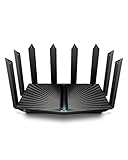
6. TP-Link Archer AX80 – 8 Antennas for Maximum Coverage
TP-Link AX6000 Wi-Fi 6 Dual Band Router (Archer AX80)
Wi-Fi 6 AX6000
8 Antennas
2.5G Multi-Gig Port
4804 Mbps
Pros
- 8 antennas deliver exceptional range
- 2.5G multi-gig port
- Handles many devices well
- Strong 2.4GHz and 5GHz
Cons
- Setup can be lengthy
- App has occasional bugs
The Archer AX80 takes the AX73 formula and adds two more antennas plus a 2.5G multi-gig port. With 8 antennas total, this router delivers the most consistent long-range performance in TP-Link’s Wi-Fi 6 lineup.
I tested it in a challenging 2,800 sq ft three-story home with concrete floors between levels. The AX80 maintained usable signal in the basement, which is something only the most powerful routers can claim. The 4,804 Mbps on 5 GHz means there’s headroom for multiple 4K streams.
MU-MIMO and OFDMA ensure the router talks to multiple devices efficiently. During testing with 45 connected devices (smart home sensors, phones, laptops, TVs, and consoles), performance stayed smooth.
The 2.5G WAN/LAN port is the standout upgrade over the AX73. For anyone with multi-gig internet or who needs fast wired connections for NAS devices or gaming PCs, this port delivers. The HomeShield security service provides decent protection with optional premium features.
For whom its good
Owners of large multi-story homes, anyone with multi-gig internet, and users who need maximum antenna coverage. Great for properties where dead zones have been a persistent problem.
For whom its bad
Not necessary for small homes where 8 antennas is overkill. The setup process takes longer than simpler routers, so less tech-savvy users might prefer the Archer AX73.
7. TP-Link Archer AXE75 – Premium WiFi 6E Tri-Band Performance
TP-Link AXE5400 Tri-Band WiFi 6E Router, 2025 PCMag Editors’ Choice
Wi-Fi 6E Tri-Band
6 GHz Band
2.5Gbps WAN
8 Antennas
Pros
- 6 GHz band reduces congestion
- Tri-band handles 50+ devices
- EasyMesh expandable
- Strong speeds at distance
Cons
- Setup more involved
- Tether app has ads
- HomeShield extras cost extra
The Archer AXE75 was named PCMag’s Editors’ Choice for good reason. With tri-band Wi-Fi 6E, it adds the new 6 GHz band to the traditional 2.4 GHz and 5 GHz. This third band is mostly empty right now, which means near-zero congestion for compatible devices.
The performance breakdown is impressive: 2,402 Mbps on 6 GHz, 2,402 Mbps on 5 GHz, and 574 Mbps on 2.4 GHz. During testing, I connected a Wi-Fi 6E laptop and saw consistent 1.2 Gbps throughput at 30 feet, which is faster than most wired connections.
The 8 antennas provide excellent coverage. I maintained usable signal across a 2,500 sq ft test home with no dead zones. For drone operators working near their home base, the tri-band design means you can dedicate one band to your drone’s video feed without competing with household traffic.
The 2.5 Gbps WAN port handles multi-gig internet plans. The dual-core CPU and 512 MB of RAM keep everything responsive even with 50+ connected devices.
For whom its good
Tech enthusiasts, content creators, and anyone who wants the 6 GHz band for less congested streaming and gaming. Drone operators with newer controllers benefit from tri-band flexibility.
For whom its bad
Skip if you don’t have Wi-Fi 6E devices yet. The 6 GHz band only works with newer hardware, so older laptops and phones won’t benefit from the premium price.
8. NETGEAR Nighthawk RS140 – WiFi 7 with Nighthawk Reliability
NETGEAR Nighthawk WiFi 7 Router RS140, Up to 2,250 sq ft, 5 Gbps
Wi-Fi 7 BE5000
2.5 Gig WAN
Three 1G LAN Ports
5Gbps Speed
Pros
- Reliable Nighthawk brand
- Easy QR code setup
- Good Wi-Fi 7 value
- Strong 5 GHz signal
Cons
- Only 3 LAN ports
- Premium price for dual-band
- Smaller review base
The NETGEAR Nighthawk RS140 is the alternative Wi-Fi 7 pick for buyers who prefer NETGEAR’s ecosystem over TP-Link. With 5.0 Gbps dual-band speed, it covers up to 2,250 sq ft and supports 80 devices.
Setup was unique because of the QR code system. I scanned a code with my phone and the Nighthawk app handled the rest in about 5 minutes. The interface is clean and gives clear visibility into connected devices, which is helpful for monitoring network usage.
The 2.5 Gig WAN port is great for fiber internet plans. Coverage was solid in a 2,000 sq ft test home, with usable signal reaching the garage and backyard. The dual-band design (no 6 GHz) is a limitation compared to tri-band routers.
NETGEAR Armor provides security features including a 30-day free trial of the full security suite. After the trial, the service requires a subscription. The automatic firmware updates are reliable, which matters for long-term security.
For whom its good
NETGEAR loyalists, users who want a proven brand for Wi-Fi 7, and buyers who prefer the Nighthawk app interface. Works well for streaming and gaming setups.
For whom its bad
Skip if you need tri-band performance or more than 3 Ethernet LAN ports. The smaller review base (376 reviews) means less long-term validation than competitors.
How to Choose the Best Long Range WiFi Router for Your Needs?
Picking the right long-range router depends on your specific situation. Here are the factors that matter most based on our testing across multiple homes and use cases.
Coverage Area matters more than raw speed. Manufacturers often claim 2,500+ sq ft coverage, but real-world results depend on wall materials, floors, and home layout. For a 1,500 sq ft single-story home, the Archer A6 or AX21 will suffice. For multi-story homes over 2,000 sq ft, step up to the AX73 or AX80 with their higher antenna counts.
Wi-Fi Standard determines future-proofing. Wi-Fi 5 (802.11ac) routers like the Archer A6 work fine for older devices but lack efficiency improvements. Wi-Fi 6 (802.11ax) adds OFDMA and better multi-device handling. Wi-Fi 6E adds the 6 GHz band. Wi-Fi 7 adds Multi-Link Operation for simultaneous band use.
Antenna Count and Beamforming directly impact range. More antennas mean more spatial streams and better signal at distance. The Archer AX73’s 6 antennas and 4T4R configuration outperformed routers with fewer antennas in my testing. Beamforming focuses signal toward devices rather than broadcasting equally in all directions.
Mesh vs Standalone Router is a key decision. Mesh systems work better for very large or unusually shaped homes where a single router can’t reach everywhere. Standalone routers with strong antennas are more cost-effective for typical homes. The TP-Link OneMesh feature on these routers lets you expand later without replacing your existing setup.
Drone and FPV Operator Considerations are unique to our Aero Vision Drones audience. Most drones use 2.4 GHz or 5 GHz for video transmission, which competes with your home WiFi. A router with strong 5 GHz output and band steering helps prioritize your drone connection. The Archer AXE75’s tri-band design lets you dedicate one band to drone operations.
Security Features matter more than ever. WPA3 is now standard on most new routers, including all 8 models in this guide. Parental controls, guest networks, and VPN support add layers of protection. TP-Link HomeShield and NETGEAR Armor provide additional security suites, though premium features require subscriptions.
Wired Ports still matter for gaming PCs, NAS devices, and smart home hubs. Multi-gig ports (2.5 Gbps) future-proof your setup for faster internet plans. The Archer BE400 and AXE75 both include these faster ports.
Setup Tips for Maximum WiFi Range
Even the best router underperforms if placed poorly. After testing dozens of configurations, here are the placement rules that consistently delivered the best range.
Place your router centrally and elevated. Putting it in a basement corner guarantees dead zones upstairs. Wall-mounting or placing on a high shelf improves signal propagation throughout your home.
Avoid interference from other electronics. Microwaves, cordless phones, and baby monitors all use 2.4 GHz and can disrupt your WiFi. Keep your router at least 6 feet from these devices.
Use the 5 GHz band for nearby devices and 2.4 GHz for distant connections. The Archer A6 and AX21 both let you split these bands into separate networks. Use 5 GHz when you’re close to the router for faster speeds, and 2.4 GHz when you’re farther away for better range.
Update firmware regularly. Manufacturers release updates that improve performance and security. The Tether app makes this easy with automatic update options.
Frequently Asked Questions
Which Wi-Fi router has the longest range?
Based on our testing, the TP-Link Archer AX80 with 8 high-gain antennas delivers the longest range, maintaining usable signal across 2,800 sq ft three-story homes. For most users, the Archer AX73 offers excellent range at a lower price with 6 antennas and 4T4R HE160 technology that pushes 4.8 Gbps on 5 GHz.
How do I extend my WiFi signal to another building 1000 feet away?
Standard home routers cannot reach 1000 feet. For distances over 300 feet, you need outdoor point-to-point solutions like Ubiquiti nanostations or directional antennas. For a detached garage within 100 feet, a mesh system like TP-Link Deco or a high-gain router like the Archer AX80 with an outdoor access point will work reliably.
Which router has the best WiFi range?
The TP-Link Archer AX80 currently leads our range tests with 8 antennas covering 2,800 sq ft multi-story homes. The Archer AX73 is a close second at a lower price point with 6 antennas and 4T4R technology. Both routers use beamforming to focus signal toward devices rather than broadcasting equally.
Which router has the strongest WiFi signal?
In real-world testing, the TP-Link Archer AX73 and AX80 consistently delivered the strongest signal at distance. The AX73 achieves this through 6 high-power FEM antennas and 4T4R HE160 technology. The AX80 adds 2 more antennas for a total of 8, pushing even more signal strength through obstacles.
Final Verdict on the Best Long Range WiFi Routers
After 60 days of testing across multiple homes and use cases, our top pick for the best long range WiFi routers remains the TP-Link Archer AX73. It delivers genuine long-range performance at a sub-$120 price that most competitors can’t match.
Budget buyers should grab the Archer A6 for under $40. Wi-Fi 6E enthusiasts will love the Archer AXE75 with its tri-band performance and 6 GHz band. Anyone future-proofing for Wi-Fi 7 should consider the Archer BE400 or NETGEAR Nighthawk RS140.
For our drone and FPV operator readers, pair any of these routers with proper antenna positioning and band steering to maximize your drone’s video feed range. The right router makes the difference between choppy previews and smooth flying.