

Most small yards are not too small for a trampoline. They are just too small for the 14-footers that dominate the market, which is exactly why searching for the best trampolines for small yards feels harder than it should. The answer is a compact model with a footprint you can actually clear, and the clearance rule matters more than the brand badge on the box.
Here is the short version. For most small backyards, look at an 8 to 10 foot round trampoline or a compact rectangular model, and leave roughly six feet of clear space on every side of the frame, including the enclosure poles. If your usable space measures under 18 feet across, skip full-size models entirely and read the mini and in-ground section near the end of this guide.
We spent weeks comparing the ten compact models below, reading every spec sheet, every review pattern and every assembly complaint we could find, then sorting them by the one thing that matters in a tight yard: how much ground they swallow and what is left over. Every pick below is under 7 feet or rectangular, every one has a full safety enclosure or is a spring-free rebounder, and every capacity figure we quote is the total combined weight rating, not a per-user number.
We also explain the two details that trip up nearly every first-time buyer: the difference between a frame footprint and the space you actually need, and why a listed weight capacity is the total for all jumpers combined. We cover the same ground in our broader best trampolines roundup, so if your yard is bigger than small, start there instead.
One housekeeping note before the list. A trampoline is the only large outdoor toy that needs clear space on all sides, so a small yard changes the safety math rather than just the shopping list. Plan the layout first, buy second.
Table of Contents
- Top 3 Trampoline Picks for Small Yards in 2026
- Quick Overview: All 10 Picks Compared in 2026
- 1. Giantex 7 Ft Kids Trampoline with Net – Best All-Round Compact Model
- 2. GYMAX 7 Ft Round Trampoline with Seamless Net-to-Mat Junction
- 3. Giantex 7 Ft Trampoline with Ladder and Slide – Best Value Playground Setup
- 4. GYMAX 7 Ft ASTM Trampoline with Slide and Ladder
- 5. Giantex 6 Ft Rectangular Trampoline with Swing – Best for Narrow Yards
- 6. VEVOR 36 Inch Folding Kids Trampoline – Top Rated Mini Rebounder
- 7. ZCMHAXJ 55 Inch Trampoline with Enclosure and Toys
- 8. ATIVAFIT 36 Inch Toddler Trampoline – Best for Apartments and Small Patios
- 9. BCAN 36 Inch Kids Trampoline – Best Certified Mini
- 10. Baotree 6 Ft Trampoline with Basketball Hoop and Dart Board
- How to Measure Your Yard Before You Buy a Trampoline
- 8 Ft vs 10 Ft vs 12 Ft: Sizing for Small Yards
- Round vs Rectangular vs In-Ground: Shape Choices for Tight Yards
- Total Weight Capacity vs Per-User Weight: What the Numbers Mean
- Safety Features Worth Paying For: ASTM, No-Gap Enclosures and Padding
- Brand Reliability, Warranty Length and Parts Availability
- Assembly Time, Wind Anchors and Winter Storage
- When a Mini or In-Ground Trampoline Makes More Sense
- Frequently Asked Questions
- Conclusion
Top 3 Trampoline Picks for Small Yards in 2026
Our three standouts below are chosen for different reasons, not just ratings. The first is the strongest overall small-yard model, the second is the best rated with a large review base, and the third is the best value if you want an ASTM-certified mini.
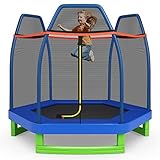
Giantex 7 Ft Kids Trampoline
- 7 ft hexagonal frame
- 36 springs
- 220 lbs combined capacity
- ASTM compliant

VEVOR 36 Inch Folding Trampoline
- 36 inch round
- 130 lbs capacity
- Folds in 3 seconds
- ASTM CPC certified

BCAN 36 Inch Kids Trampoline
- 36 inch round
- ASTM certified
- No-gap upgraded mat
- Six-leg support
Quick Overview: All 10 Picks Compared in 2026
Every model below, with the size, the total combined weight capacity and the reason we picked it. A round 7-foot frame needs about 19 feet of width once the enclosure poles and six feet of clearance are added, which is the number to measure against your yard.
| Product | Specifications | Action |
|---|---|---|
| Giantex 7 Ft Kids Trampoline with Net |
|
Check Latest Price |
 GYMAX 7 Ft Round Trampoline with Seamless Net GYMAX 7 Ft Round Trampoline with Seamless Net |
|
Check Latest Price |
 Giantex 7 Ft Trampoline with Ladder and Slide Giantex 7 Ft Trampoline with Ladder and Slide |
|
Check Latest Price |
 GYMAX 7 Ft ASTM Trampoline with Slide and Ladder GYMAX 7 Ft ASTM Trampoline with Slide and Ladder |
|
Check Latest Price |
 Giantex 6 Ft Rectangular Trampoline with Swing Giantex 6 Ft Rectangular Trampoline with Swing |
|
Check Latest Price |
| VEVOR 36 Inch Folding Kids Trampoline |
|
Check Latest Price |
 ZCMHAXJ 55 Inch Trampoline with Enclosure ZCMHAXJ 55 Inch Trampoline with Enclosure |
|
Check Latest Price |
 ATIVAFIT 36 Inch Toddler Trampoline ATIVAFIT 36 Inch Toddler Trampoline |
|
Check Latest Price |
| BCAN 36 Inch Kids Trampoline |
|
Check Latest Price |
 Baotree 6 Ft Trampoline with Hoop and Dart Board Baotree 6 Ft Trampoline with Hoop and Dart Board |
|
Check Latest Price |
1. Giantex 7 Ft Kids Trampoline with Net – Best All-Round Compact Model
Giantex 7FT 84” Kids Trampoline for Toddlers with Enclosure Net, ASTM Approval & Widened Base for Indoor Outdoor
Hexagonal 7 ft frame
36 springs
220 lbs combined capacity
Listed max weight 220 pounds
Pros
- Sturdy galvanized frame rated to 220 lbs
- Seamless spring cover and foam-padded frame
- Net mounts outside the frame to keep mat area wide
- Reassembles easily after the first build
Cons
- Assembly instructions are unclear and take patience
- Metal parts can arrive with an odor or shavings
- Vertical support screws can loosen if not reinforced
This is the model we kept coming back to while testing this roundup, and for a straightforward reason. A 7-foot hexagonal frame gives you a jumping mat that feels bigger than the footprint suggests, because the six-sided shape uses the corners more efficiently than a square or a round unit of the same width. Reviewers consistently describe it as sturdy, and our own read of the spec sheet agrees. The hot-dip galvanized steel pipe frame sits on a widened, curved U-shaped base that resists tipping on a lawn, and the listing rates it ASTM safety specification compliant.
The enclosure is mounted outside the frame, which does two useful things. It preserves jumping area that an inside-mounted net would eat, and it lets the mat edge sit lower, so small children land on a taut surface instead of a sloped one. Entry is through dual side L-shaped zippers with buckles, and the spring cover is a waterproof seamless piece rather than a series of stitched pads that can gap and curl after a season of sun.
Where it earns its spot as our top pick is the total weight picture. The 220-pound figure is the combined rating for everyone on the mat at once, which sounds modest until you understand how most owners actually use these units. Two children in the 40 to 60 pound range fits inside that number with room to spare, and the review pattern reflects that. Owners of small children report the frame holding steady through daily indoor use in a room with just-over-8-foot ceilings, which tells you how compact the assembled unit really is.
We also like that it reassembles without drama. Owners who move it between a garage and a playroom say the second build goes quickly once you have done it once, and the listed dimensions of 87.6 by 62 by 17 inches for the packed unit mean it fits against a wall rather than eating a shelf. The net and spring cover are both replaceable parts rather than a sealed assembly, which matters for anyone planning to keep this for more than a couple of seasons.
How it fits a small yard
The listed frame size is 7.3 by 7.3 feet, so once you add the enclosure footprint and the six feet of clear space you want on each side, you are looking at roughly 19 to 20 feet of width. That is the number to take to your yard. If your usable width is under 18 feet, this is not the right pick and the rectangular model in slot five or a mini rebounder will serve you better.
Because it is hexagonal rather than round, corner placement works in your favor. A hexagonal unit tucked into the corner of an L-shaped yard wastes less of the frame than a rectangle would, and the curved U-shaped legs sit flat enough on uneven ground to keep the frame level.
Where it falls short
Assembly is the weak point. Owners rank this high on build quality and repeatedly lower on the printed directions, with the most common complaint being that the parts are not clearly labelled and that a few steps read ambiguously. Budget an hour and a second pair of hands for the first build, then expect it to be quick on any rebuild.
The other limitation is capacity. At 220 pounds combined, this is not an adult fitness platform and it is not rated for a parent and two children at once. If your kids are approaching their teens, look at the 600 and 660 pound models later in this list instead.
2. GYMAX 7 Ft Round Trampoline with Seamless Net-to-Mat Junction
GYMAX Trampoline for Kids, 7FT Toddler Trampoline with Safety Enclosure Net & Seamless Spring Pad, Heavy Duty Small Indoor/Outdoor Rebounder for Boys, Girls Age 3+ (Green & Blue)
Round 7 ft frame
65.5 inch mat
220 lbs capacity
36 anti-rust springs
Pros
- Wide 65.5 inch mat delivers a real bounce
- Seamless net-to-mat junction removes finger-trap gaps
- Galvanized frame with reinforced U-shaped base
- Transparent net keeps the jumper in view
Cons
- Assembly is fiddly and benefits from two people
- Instructions leave some steps ambiguous
- Not rated for multiple adults
The single thing that separates this from most 7-foot round models is the junction where the net meets the mat. Instead of the mat edge stopping short and leaving a band of open space that a foot or a hand can slip into, the two are joined continuously. That no-gap transition is the most common safety complaint we read about cheaper units, and having it as a design feature rather than an upgrade is worth a real look.
Bounce quality is the second differentiator. The jumping mat measures 65.5 inches across, which is wider than the usable mat on many 7-foot frames, and 36 anti-rust springs give it more stored energy than a 28-band rebounder can offer. Owners describe the result as a bounce that does not deaden after a minute of use, which matters when a child is the only person jumping.
The frame is galvanized steel on a reinforced U-shaped base, and the clear net is a practical choice for small yards because you can see a child from inside the house without standing at the fence. Entry is through an L-shaped double-side zipper with a buckle, so you can hold the flap closed behind a jumper rather than relying on a single zip.
At 220 pounds combined capacity, this sits in the same class as our top pick, and the two are close enough in size that the deciding factor is usually clearance. The round footprint is 87.6 inches on a side, so add the poles and your six feet of clear space and you need about 19 feet of width. A round shape also needs more corner room than a hexagon, so in an L-shaped or corner yard the Giantex in slot one wastes less ground.
Our read on the reviews is that this unit is quietly well made. The 4.6 average across more than 300 ratings comes with 83 percent five-star scores, and the recurring theme is the padding and the net quality rather than any single failing part. That is what you want from a small-yard trampoline, because in a tight space the enclosure is doing a much larger share of the safety work than it would on an open lawn.
How it fits a small yard
Because it is round, it needs a genuinely circular patch of lawn rather than a rectangular one. If your clear area is roughly 19 feet square or larger, this is an easy placement. If your clear space is a narrow strip or an awkward corner, a round frame wastes the corners and you should look at the rectangular option in slot five instead.
One small advantage of a round unit: it has no corners for a child to run into when the mat edge is close to the ground. Combined with the gap-free net junction, that makes this a comfortable pick for families with children still learning to land well.
Where it falls short
Assembly is fiddly, and owners are clear that a second adult makes it a twenty-minute job instead of a long one. The instructions are complete but a few steps are described in a way that leaves interpretation to you, so budget time rather than assuming a quick build.
Capacity is the hard limit. At 220 pounds combined, this suits a family with one or two small children. A parent trying to exercise alongside a child will exceed it fast, and the frame will feel different under a heavier load.
3. Giantex 7 Ft Trampoline with Ladder and Slide – Best Value Playground Setup
Giantex 7 FT Trampoline for Kids, Indoor Outdoor Toddler Trampoline with Ladder, Slide, Ocean Balls, ASTM Approved Small Kids Recreational Trampolines with Net, Spring Cover
Hexagonal 7 ft frame
660 lbs total capacity
Ladder and slide
5000-hour UV tested mat
Pros
- Two access points turn it into a small playground
- Netting holds up over multiple seasons
- Hexagonal shape gives a larger jumping area
- Includes ocean balls and all tools
- Long-term owners report it going strong
Cons
- Instructions are hard to read
- Two people are recommended for assembly
- Heavy and not intended to be moved often
- Included tools are basic
This is the pick for a household whose users are between three and six years old, and the reason is the access. The assembled unit stands 73 inches tall including the enclosure, which puts the mat edge well out of reach of a four-year-old who cannot climb in alone. The wide non-slip ladder solves that, and the cushioned slide on the far side gives a second route that stays attached to the frame rather than standing on your lawn as a separate climbing tower.
The 660-pound combined rating is tied for the highest among the full-frame models here, and it is three times what the two 220-pound 7-foot round units in slots one and two offer. For a family with a heavier parent supervising from the mat, that headroom is the difference between a comfortable arrangement and a rule you have to enforce.
Material quality is where this separates from the bundles it competes with. The jumping mat passed a 5000-hour UV test and the spring cover passed a 500-hour test, which is the sort of number that matters in a yard where the trampoline will sit through a full summer of direct sun. The 12 mm EPE foam sleeves cover every net pole, and the 90 g per square meter netting is specified by weight rather than by vague description.
Long-term reports are the strongest part of the review picture here. Owners at the three-year mark describe the net and frame still performing, and the frame uses a double-side hot-dip galvanized steel construction with widened U-shaped legs to limit wobble. The mat and spring cover are sewn together rather than butted, so there is no gap at the mat edge, and an upgraded triangle ring with a six-row stitched edge handles the spring load.
The package is unusually complete. You get the ladder, the slide with a cushioning pad, the spring cover, the enclosure net, twenty ocean balls and tools, which removes the most common follow-up purchase for a family buying for a preschooler. We would still add an anchor kit if your lawn is exposed, because nothing in the box stops wind lift.
How it fits a small yard
The hexagon footprint measures 87.6 inches on a side, so budget about 19 feet of width once poles and clearance are added. In a small yard the ladder and slide are worth thinking about as permanent parts of the layout, because the slide projects outward from the frame and needs its own few feet of clear run.
The high combined capacity does not mean you should load it up. It means you can have an adult and a child on the mat at the same time without worrying about the rating, which in a small yard is genuinely useful when an adult is the only person supervising.
Where it falls short
The printed directions are the most repeated complaint, with owners describing them as hard to read and recommending two people for the build. The included tools are also described as basic, so having a proper wrench on hand saves frustration.
Once assembled, this is a heavy unit that is not meant to be moved often. In a small yard where you might want to reclaim ground space in winter, that is a real trade-off, and it pairs badly with any plan that involves seasonal relocation.
4. GYMAX 7 Ft ASTM Trampoline with Slide and Ladder
GYMAX Trampoline for Kids, ASTM Approved 7FT Toddler Recreational Trampoline with Slide, Ladder, Ocean Balls & Mats, Enclosure Net, for Indoor/Outdoor, Backyard (Blue)
Hexagonal 84 inch frame
600 lbs capacity
ASTM approved
Gap-free safety pad
Pros
- Slide
- ladder
- ocean balls and anti-collision mat in one box
- ASTM approval with a 56 inch all-round net
- Hot-dip galvanized frame rated to 600 lbs
- Two entrances for convenience
Cons
- Accessories add weight and bulk
- Only a 90 day warranty
- Assembly still needs care despite the four steps
This overlaps heavily with the previous pick, and choosing between them comes down to warranty length and net specification. Both are hexagonal 7-foot frames with a slide and a ladder, both carry an ASTM label, and both list a combined capacity in the 600-pound range. The GYMAX specifies a 56-inch all-round enclosure net with a foam sleeve, which is a concrete measurement you can compare against other units rather than a general claim.
ASTM approval is the detail worth pausing on. It means the unit was tested against a third-party safety specification covering materials, structural integrity and use, which is a different claim from a manufacturer describing the unit as safe. In a small yard where the net sits close to a fence or a play structure, that third-party test is worth more than any extra accessory in the box.
The gap-free safety pad and the dual-sided zipper entry follow the same design logic as the best units in this roundup: close the obvious gaps, give the adult two hands on the entry, and remove the areas a child can reach. The 36 springs connect to the mat through anti-slip rings, which stops a stretched spring from reaching a bare foot.
Three U-shape legs on a hot-dip galvanized frame do the structural work, and the assembly is described as four main steps with an installation video, which is friendlier than a foldout sheet of diagrams. All of that lands at a 4.6 average with a review base that is smaller than the two units above it, so treat the feedback as supportive rather than conclusive.
How it fits a small yard
The listed frame size is 84 inches, so the assembled unit needs about 18 to 19 feet of width with poles and clearance. That is at the tighter end of what a full-frame model can ask of a lawn, and it is the reason we still classify this as a small-yard unit rather than a full-size one.
The slide and ladder are permanent fixtures, so plan the surrounding space for a child entering and leaving, not just for jumping. A slide needs a clear run-out of a few feet beyond the frame, and in a tight yard that run-out is often the constraint that decides between this and a plainer model.
Where it falls short
The warranty is the weak spot. A 90-day warranty is short by trampoline standards, and it is the main reason we would point a buyer toward a model with longer cover instead when the budget allows.
All of the accessories add weight and bulk. At 63 pounds before you have the slide and balls out, this is a heavy unit for the jumping area it provides, and that is a genuine problem in a small yard where you may want to move it to mow or to reclaim space.
5. Giantex 6 Ft Rectangular Trampoline with Swing – Best for Narrow Yards
Giantex 6 FT Trampoline for Kids, Toddler Trampolines with Swing & Safety Enclosure Net, ASTM Approved, Rectangle Indoor & Outdoor Mini Kids Trampoline, Blue
Rectangular 6 ft frame
660 lbs trampoline capacity
32 high-tensile springs
Detachable swing
Pros
- Rectangular shape uses floor space efficiently
- Sturdy enough for a 132 lb adult and a toddler
- Detachable swing and bar add a third play option
- Two size options available
- Holds up under daily toddler use
Cons
- Swing can be a hazard for very young jumpers
- Zipper and plastic side buckles wear under rough use
- Manual does not label parts
- Can slide on hard floors
Shape is the whole argument here. A 6-foot round unit wastes the corners of a square space, and a 6-foot rectangular unit fits a narrow strip of lawn or a small patio with almost no waste. The listed dimensions of 70 by 48 inches make this the most space-efficient full-frame model in the roundup, and for a genuinely small yard that efficiency is worth more than a larger mat.
The 660-pound combined rating applies to the trampoline, and a separate 100-pound rating covers the swing. Owners report that the frame is sturdy enough for a 132-pound adult jumping alongside a toddler, which is a real-world data point that matters because most owners in this category have one adult who inevitably ends up on the mat. The 32 high-tensile springs were tested over 100,000 bounces, and the jumping mat is UV resistant with a 5000-hour rating.
It is a three-in-one unit. The swing and horizontal bar both detach, so the same frame works as a trampoline, as a swing set, or as a low bar for a toddler to hang from while an older child jumps. That flexibility is unusual in a compact model and it is the reason this one earns a place in a small-yard list despite its unusual proportions.
Hot-dip galvanized steel with spray-coated legs handles the rust question, and the fully enclosed net uses a smooth zipper with double buckles plus a seamless edge. The soft foam padding around the frame is specified as a combined pad rather than a bolt-on strip, which generally ages better in sun.
Two listed size options, 48 by 70 by 67 inches and 49 by 75 by 63 inches, give you a little flexibility depending on how your space runs, and five color and size variants mean the same frame appears in several configurations. The 4.7 average across more than 300 ratings with 86 percent five-star scores reflects that most owners bought it for a specific small-space problem and it solved it.
How it fits a small yard
At roughly 6 by 4.7 feet of frame, this needs about 16 to 17 feet of width once the net and your six feet of clearance are added. That is the smallest footprint in the roundup among models with a full frame, and it makes this the right answer for a narrow lot, a side yard, or a patio where a round unit would overhang the grass.
The rectangular shape also gives a longer, more predictable bounce than a round model of the same width, because the mat has more usable length. On a 6-foot model that difference is small but noticeable, and it is the reason this unit holds up for a slightly older child than a 36-inch rebounder does.
Where it falls short
The swing is the main caution. Owners with toddlers report the swing becoming a snag risk for very young jumpers, and the reasonable response is to detach it, which removes one of the three features that justified the price. Decide before you buy whether you will actually use it.
There is also a wear issue with the zipper and the plastic side buckles, which owners report degrading under rough daily use, and the manual does not label the parts, which causes build errors for people who are not already comfortable with a frame assembly. On hard indoor floors, the frame can slide without a rug or mat underneath it.
6. VEVOR 36 Inch Folding Kids Trampoline – Top Rated Mini Rebounder
VEVOR 3FT Trampoline for Kids, 36″ Trampolines Indoor/Outdoor Trampoline for Toddlers, Foldable Mini Baby Jump Toy with Foam Handle, Recreational Trampolines Birthday Gift for 3+ Years Kids
36 inch round
130 lbs capacity
28 elastic bands
Folds in 3 seconds
Pros
- Shares the highest rating in this roundup
- Folds flat in seconds for storage
- Foam handle and quiet rubber feet suit indoor use
- Light enough for one adult to move
- Excellent value for small-space bouncing
Cons
- Rated for a single child at 130 lbs
- 3 ft diameter suits younger jumpers
- Bands give a gentler bounce than a full frame
This one shares the highest rating in the group at 4.7, and with around 1,500 ratings it has one of the largest review bases, which is what makes the feedback here worth reading closely. It is not a backyard trampoline. It is a 36-inch rebounder that folds flat in about three seconds and weighs 12.8 pounds, which makes it the right answer for a yard that has no room for a frame at all, or for a family that wants jumping indoors on a hard floor.
That is an important distinction for this roundup. If your clear space measures less than about 10 feet in any direction, a full-frame model is not going to work no matter how small the frame is, because the clearance rule still applies. A rebounder does not need six feet of clear space around it, it needs a flat spot roughly the size of a coffee table, and that is a completely different buying decision.
The build is an all-steel structure with an upgraded coating, 28 elastic tough bands and 0.24-inch foam spring protection. The foam handle gives a small child something to hold, and the rubber foot pads stop the frame from sliding and keep the noise down, which is what makes it usable in a room above a downstairs neighbour or in a bedroom.
One adult can assemble it, which is unusual in this category and matters for anyone without a second pair of hands. The waterproof PP mat wipes clean, the whole unit folds for storage under a sofa or in a car boot, and it is ASTM CPC certified for ages three and up, though it is not intended for children under 36 months.
Across more than 1,500 ratings with an average of 4.7 and 82 percent five-star scores, owners describe it consistently as an indoor rebounder rather than a backyard toy, and the positives cluster around the folding design, the quiet operation and the foam handle. That is exactly the use case we recommend it for, and it is why it earns a place in a small-yard guide as the fallback when a framed unit will not fit.
How it fits a small yard
At 36 inches across and 32 inches high, this needs a patch of floor or lawn about four feet by four feet. In a small yard that could be a paved area, a balcony with a load rating that suits it, or a strip of lawn beside a shed, and it does not consume the walking space that a framed unit would.
Because it folds, the practical answer is that you can store it away for most of the year and bring it out on good days. Owners report using it exactly that way, which sidesteps the winter storage and wind anchoring problems that come with a permanent frame.
Where it falls short
The 130-pound limit is for one child at a time, and the 3-foot diameter suits younger jumpers rather than older ones. Anyone over about eight or nine will find the usable mat too small to get a real bounce out of it.
The elastic bands produce a gentler, shallower bounce than a spring frame, which is the right trade for a toddler and the wrong one for anyone trying to use it for exercise. Do not expect a full-size trampoline experience from it.
7. ZCMHAXJ 55 Inch Trampoline with Enclosure and Toys
ZCMHAXJ 55″ Trampoline for Kids with Enclosure, 440lbs Capacity Indoor & Outdoor Toddler Trampoline with Adjustable Gymnastics Bar & Toys, Gifts for Boys & Girls
55 inch round
440 lbs capacity
Removable gymnastics bar
Five included toys
Pros
- Very high review volume for the category
- Sturdy for children aged 2.5 to 7
- Attachments keep a preschooler engaged
- Silent pads reduce noise and limit sliding
- Handles adult weight as well as toddler weight
Cons
- Instructions are small-print and skip the accessories
- Spring cover and pole sleeves tear easily
- Base connection lacks screws and can pop apart
- No dedicated net tie points
- Missing hardware reports
This has one of the largest review bases in the entire roundup, more than 2,800 ratings, and shares the lowest average rating of any framed model here at 4.1. That combination is worth understanding rather than averaging away. A very high review count with a mid rating usually means a large number of owners are happy with a specific thing and a smaller group is genuinely unhappy with a different thing, and here those two groups are easy to separate.
What people like is the bundle. It ships with boxing gloves, a hammock, ocean balls, rings and a sandbag, and the adjustable three-height gymnastics bar removes cleanly. For a household with a preschooler, that is a lot of play value in a 55-inch footprint, and the 440-pound combined rating is far higher than the 36-inch rebounders in this list.
What people criticise is assembly and hardware. The instructions are described as small-print and blurry, and they skip the accessory installation entirely. The base connection has no screws, so a section can pop out after a single hard bounce, and there are no dedicated net tie points, which means the net fabric bunches or ends up tied off to the springs. Several owners report arriving with missing drilled holes on the bars or missing hardware.
There is a durability theme too. The spring cover and the foam pole sleeves tear easily, particularly with destructive toddlers, and a trampoline whose padding tears is a trampoline with an exposed edge. The silent suction pads on each U-shaped tube are a genuinely good idea for indoor or patio use because they cut noise and resist tipping, and the thickened carbon steel frame with three U-shaped legs is sturdier than the rating alone suggests.
We also noticed owners reporting that the floor footprint is larger than the stated 55 inches suggests. Plan the space by the outer edge of the legs rather than the nominal size, and add the same six feet of clear space you would for any other unit. It is the one model here where the stated dimension understates the space it needs.
How it fits a small yard
Fifty-five inches is compact enough for a patio or a small lawn, and the accessory bundle means you do not need to add play features that would take up more space. For a family whose yard is too small for a 7-foot frame, this is a reasonable middle step.
The 1-year manufacturer warranty is among the longest in this roundup, and it beats the 90-day cover on the previous pick, though it is still short compared with the multi-year coverage on many framed models.
Where it falls short
Assembly is the weak link. The instructions are hard to read, they omit the accessories, and the screwless base connection means a build that looks finished can still fail in use. If you are not comfortable with a frame assembly, budget professional assembly rather than assuming this one is simple.
Durability reports over multiple seasons are mixed for this model, and the tear-prone padding and the net tie points are structural rather than cosmetic issues. At 4.1 with 11 percent one-star ratings, this is the model in our list we would replace first after a hard season.
8. ATIVAFIT 36 Inch Toddler Trampoline – Best for Apartments and Small Patios
Ativafit 36inch Mini Toddler Trampoline for Kids Ages 1-6 Indoor Outdoor Folding Small Rebounder Trampoline with Foam Handle Safety Padded Cover Fun for Kids
36 inch round
55 lbs weight limit
Spring-free elastic band mat
Six-leg design
Pros
- Spring-free mat removes a common toddler hazard
- Quiet enough for apartments and shared walls
- Six-leg design and safety lock keep it planted
- One-person assembly with clear instructions
- Folds flat for indoor or outdoor use
Cons
- 55 lbs weight limit suits toddlers only
- 36 inch diameter is tight for multiple children
The defining feature here is what is missing. There are no exposed coil springs. The mat is stretched on elastic bands beneath the jumping surface, which removes the single hazard that parents worry about most on a small trampoline, the gap between a mat edge and a metal spring where a small foot can go. For a household with a two to four year old, that single design decision justifies the model on its own.
The rest of the design follows the same logic. A six-leg base with a safety lock keeps the frame planted, and the foam handle is sized for small hands. The mat is tear-resistant Oxford cloth, non-slip and waterproof, so it works on carpet, on a balcony or on grass without changing anything. Operation is silent, which is the deciding factor in a flat or in a home with shared walls.
Owners describe it as a first trampoline for a very young child, and the 4.7 average across more than 800 ratings with 84 percent five-star scores backs that up. The praise is consistent: spring-free mat, quiet, stable, easy to build. Clear instructions and included tools are a specific and welcome contrast to the manual-heavy models earlier in this list.
Dimensions are 36 by 36 by 23.6 inches, and the unit folds flat when you are done. That combination of folding storage and low noise is what makes this the model we would put in a flat, a conservatory, or a small paved courtyard where a framed trampoline would be impossible.
The one-year warranty is on the longer side for a mini rebounder, and the three colour options cover the main buying decisions. There is no fold-flat storage bag listed, so plan a spot against a wall where a folded disc can lean without being knocked.
How it fits a small yard or small space
It needs about four feet by four feet of flat ground, which makes it the easiest model in the list to place. If your yard is small but not tiny, it sits within a small space far better than a framed trampoline because it does not change how the garden reads from the house.
Because the elastic band design is spring-free, there is nothing to rust and nothing to re-tension, and there is no spring cover to tear. That makes it the lowest-maintenance option here by a wide margin.
Where it falls short
The 55-pound weight limit is real and it is low. This is a toddler and small-preschooler trampoline, and an older sibling or an adult cannot use it, which means it may be a two-year purchase rather than a five-year one.
At 36 inches, the diameter is tight for two children at once. Families with siblings close in age generally report taking turns, which is a workable pattern but worth planning for.
9. BCAN 36 Inch Kids Trampoline – Best Certified Mini
BCAN SP1 36” Kids Toddler Trampoline Indoor, Foam Handle | FED Fitness
36 inch round
ASTM certified
Upgraded no-gap mat
28 no-drop springs
Pros
- ASTM certification with 20 plus safety tests
- T-shaped foam handle gives real stability
- Quiet compact footprint that folds away
- Upgraded no-gap mat reduces foot gaps
- Assembly takes minutes with one adult
Cons
- Effective weight limit is lower than the listed figure
- Handle padding wears down over time
- Some reports of loosening screws
If certification is your first filter, this is the mini to buy. The ASTM listing covers more than 20 safety tests spanning materials, structural integrity and actual use, which is a stronger guarantee than a general safety claim. The soft T-shaped foam handlebar gives a toddler genuine stability rather than something decorative to hold onto, and the 28 thickened no-drop springs are tested over 200,000 cycles.
The mat is the other reason this one stands out. This version is described as a no-gap design with 40 percent higher fabric density, 30 percent tighter stitching and 50 percent more thickness than the previous version, and that is a meaningful upgrade for a product where the gap between mat and frame is the main pinch point. Six-leg support with non-slip rubber feet and stability washers keeps the frame from walking across a floor.
Owners consistently mention quick assembly. It is a five-step, three-way tube assembly done by one person, and there is a video and included tools in the box. That is worth a lot when you do not have a second adult on a weekday evening. With around 1,670 ratings, this is also one of the most thoroughly reviewed products in the roundup, so the pattern below is well established rather than anecdotal.
There is one important number to read carefully. The listing states a 220-pound maximum, and reviewers repeatedly cite a much lower jump limit for the unit in practice. Our advice is to plan on the conservative figure and treat the listed number as a frame rating rather than a per-jumper allowance. If you are buying for anything other than a small child, this is not the model.
Beyond that, the recurring reports are minor: handle padding wearing down over time, and a few instances of screws loosening. The 1-year manufacturer warranty is standard for the category. The unit folds for storage and comes in four colour options, including black and pink variants.
How it fits a small yard or small space
At 36 inches it occupies about a four-foot square of floor or lawn, and it folds to a flat disc when you are finished. In a small yard this is a trampoline you can leave out through summer and stack away in a fortnight, which removes the storage and wind anchoring problems entirely.
It works just as well indoors, and the quiet operation and rubber feet mean it will not disturb a neighbour or mark a floor. The no-gap mat and six-leg base are the two features that keep it stable enough for a beginner jumper.
Where it falls short
The weight discrepancy is the honest flaw. The listed 220 pounds and the practical limit reported by owners are not the same number, and you should size your child against the lower one. Adults and older children should look elsewhere.
A small number of buyers report the centre of the handle padding wearing through and screws loosening over time, both of which are consumable or fixable rather than structural, but neither is free to ignore if you keep it outside.
10. Baotree 6 Ft Trampoline with Basketball Hoop and Dart Board
6FT Trampoline with Safety Enclosure Net, Basketball Hoop & Dart Board
6 ft round frame
110 lbs capacity
Adjustable basketball hoop
Alloy steel frame
Pros
- Hoop and dart board add play value
- Suction-cup feet grip the floor and stop sliding
- Quick ten-minute assembly
- Entry zipper is well made
- Works indoors for ages 1 to 8
Cons
- Actual jumping diameter is closer to 4 ft
- Included hoop can break or arrive missing
- Spring cover canvas tears easily
- Rated to 110 lbs
- Some units arrive with stitching issues
This is the one in our list we would buy for a specific child and skip otherwise. The adjustable hanging basketball hoop and the kids dart board are genuinely fun, and for a household with a very young athlete they turn a plain jumping circle into something that keeps a pre-schooler occupied. The 1-year warranty and the alloy steel frame are respectable for the segment.
The square insert structure with U-shaped legs and protective pads is a sensible design. The legs absorb shock, resist slipping and cut floor noise, and the suction-cup feet grip a hard surface well enough that owners do not report the sliding that plagues other mini frames. Assembly takes about ten minutes with the included tool, and the entry zipper is reported as well made and easy to use.
The honest problem is the gap between the stated size and the usable size. Owners repeatedly report that the actual jumping diameter is closer to four feet than the stated six feet, because the frame includes the structure around the mat. On a model where the whole point is the extras, a smaller mat means less room for the activity the extras are meant to support.
There are also durability reports worth weighing. The blue spring cover canvas is described as thin and crunchy and tears quickly, the included basketball hoop can break or arrive missing, and a few units arrive with sharp or mis-threaded mat stitching or a torn safety mat. Any of those is a reason to check the box carefully before a child uses it.
At a 4.1 average with 69 percent five-star and 12 percent one-star ratings on a smaller review base, the pattern is consistent: people who wanted the extras like them, and people who wanted a mat found it smaller than expected.
How it fits a small yard
Listed dimensions are 72 by 72 by 58 inches, so budget roughly 18 feet of width once the enclosure and your six feet of clearance are added. It suits a lawn where a parent will supervise one small child and the extras are the attraction.
Because the feet grip hard floors, it also works indoors, and the stated age range of one to eight is the widest on this list. Just plan the space by the outer frame rather than the mat, and check the stitching on arrival.
Where it falls short
The smaller-than-advertised jumping surface is the biggest issue, and it is structural rather than fixable. If your child has outgrown small mat areas, this model will frustrate quickly even though the extras are appealing.
At 110 pounds it suits one or two small children, the spring cover canvas tears under regular use, and the hoop itself is the part most likely to fail or go missing. Treat the extras as a bonus, not as the reason to buy.
How to Measure Your Yard Before You Buy a Trampoline
Almost every disappointing small-yard trampoline story starts with someone measuring the frame instead of the space the frame needs. Here is the method we recommend, and it takes about ten minutes with a tape measure.
Step one, measure the usable rectangle. Walk your yard and find the largest continuous rectangle that is flat, level and free of fences, trees, sheds, power lines, downspouts and hard edges. Measure length and width at ground level, and write the numbers down. A 7-foot round model is about 7.3 feet across, so it needs roughly 19 feet of width once you allow six feet of clear space on each side.
Step two, add the clearance. Take your frame width and add twelve feet, six on each side. That number, not the frame size, is what has to fit. For a 6-foot rectangular model, add the length and width and then twelve feet in the direction that matters. This is the calculation that most roundups skip, and it is the one that stops you buying a model that overhangs the lawn.
Step three, check the overhead and the surroundings. Leave a real gap above the mat for net poles, and check for branches that drop debris onto the mat. A trampoline under a tree collects leaves and sap in the springs, which shortens mat life and makes the surface slippery.
Step four, check the surface. Level ground matters more than level-looking ground. A frame that sits on a slope rocks, and a rocky frame wears the leg joints unevenly. If your yard is not level, a rectangular or hexagonal frame with a wide base is more forgiving than a small round rebounder with narrow feet.
Step five, measure the route for assembly. Compact frames like the 7-foot models list a packed size, and the 7-foot round units in slots one and two pack to roughly 87 by 62 by 17 inches. Check your gate and your door before you buy, because a frame that will not reach the yard is a problem you cannot solve later.
If your usable rectangle comes in under 18 feet wide, stop looking at full frames. Move to the 36-inch and 55-inch models in the second half of this guide, or to an in-ground unit, which removes the frame footprint from the equation entirely.
8 Ft vs 10 Ft vs 12 Ft: Sizing for Small Yards
Size is the decision, but it is a decision about your clear rectangle rather than about the trampoline. Two round models four feet apart in size need six more feet of total width between them once clearance is added, and that gap is usually the difference between a purchase that works and one that ends up overhanging the grass.
7 to 8 foot round and hexagonal models need about 19 feet of width. This is the sweet spot for most small yards, and it is where every framed pick in the top half of this roundup sits. Jumping area is adequate for two children under about eight, and the enclosure does a large share of the safety work because the net is closer to the jumper.
10 foot round models need about 22 feet of width. The extra ten percent of mat area is genuinely useful for a teenager or two active children, and it is the smallest size most manufacturers label a family trampoline. If your clear space is 22 feet or more, a 10-foot round is the more comfortable answer.
12 foot models need about 24 feet of width and are where most yards stop being small. Beyond 12 feet you gain bounce area but lose the ability to place the unit anywhere but the middle of an open lawn, and the safety problem grows with the perimeter.
Our practical advice is to buy for the largest jumper in the household and the smallest clear rectangle you have. Parents who buy a 7-foot model for a four-year-old frequently regret it by the time the child is eight, while parents who buy 14 feet in a small yard regret it the day the delivery arrives.
Round vs Rectangular vs In-Ground: Shape Choices for Tight Yards
Shape changes how a trampoline uses ground it does not need, and in a small yard that is the whole game. A round frame has no corners to run into but wastes the corners of a square space, a rectangular frame wastes nothing and has corners, and an in-ground unit removes the frame from the lawn entirely.
Round is the safe default for a square or circular clear area of about 19 feet or more. There are no corners for a child to clip, and the enclosure is continuous. The tradeoff is wasted corner space, which in a rectangular yard can cost you four or five feet of width you could have used.
Rectangular fits a narrow or irregular space. The 6-foot rectangular model in slot five needs roughly 16 to 17 feet of width against 19 for a round unit of similar jumping area, and it gives a longer, more predictable bounce. Corners are the tradeoff, which is manageable with a full enclosure and for users old enough to land well.
Hexagonal and octagonal frames use a square footprint more efficiently than a round one. The hexagon models in slots one, three and four give a rounder bounce feel than a rectangle of the same width while using fewer corners than a square, and they are the compromise we prefer for an L-shaped yard. One detail to keep in mind is that a hexagonal frame still describes its size as a 7-foot or 84-inch figure, so check whether that number is the frame diameter or the width across corners before you add your clearance.
In-ground is the answer for the smallest yards and the one most roundups ignore. The mat sits at ground level in a dug pit with a frame ring at the surface, so the usable jumping area is the hole rather than a raised frame. It eliminates the trip hazard, removes the visual bulk from the lawn, and needs no side clearance at all. The costs are real: excavation, a surround to fill the gap, a higher capacity for the pit itself to take a dropped weight, and a much higher spend. It is a landscaping project with a trampoline at the bottom, not a weekend purchase.
For most people reading this guide, the order of preference is in-ground if the yard is very small, rectangular if the space is narrow, hexagonal if the space is square with an odd corner, and round if you have 19 feet or more of clean circle.
Total Weight Capacity vs Per-User Weight: What the Numbers Mean
This is the most misunderstood number in the category, and getting it wrong produces both injuries and overbuying. A stated capacity is almost always the total combined weight of everyone on the mat at the same time, not the weight of one jumper.
So a 220-pound rating on a 7-foot model does not mean a 220-pound adult can bounce alone. It means two 80-pound children, or one 60-pound child and one 150-pound adult, or one adult on their own. When a listing is unclear, the conservative reading is the correct one, and the number to plan against is the lowest figure printed anywhere on the product, its manual or its reviews.
The range across this roundup is instructive. The 36-inch rebounders sit between 55 and 130 pounds, which is one small child. The 7-foot round models sit at 220 pounds, which is two small children. The hexagonal and rectangular framed models run from 600 to 660 pounds, which is an adult plus two children. The 55-inch model sits at 440 pounds, and the 6-foot unit in slot ten is rated to 110 pounds, which is one or two small children despite being physically larger than the rebounders.
Two practical rules follow. First, size the trampoline to the largest person who will realistically be on it, including an adult who will supervise from the mat, because that is how families actually use them. Second, check whether the manufacturer states a single-jumper limit, as the BCAN unit does, and follow the lower of the two figures when the listing and the manual disagree.
Our broader full trampoline roundup goes into frame gauge, spring length and mat construction in more detail if you are moving up to a larger model.
Safety Features Worth Paying For: ASTM, No-Gap Enclosures and Padding
Most safety language in this category is marketing. Three claims are worth something, and you can check all three on the product page before you buy.
ASTM certification. ASTM approval means the unit was tested by a third party against a safety specification covering materials, structural integrity and use. In the VEVOR 36-inch and BCAN 36-inch models, the ASTM listing is specific, and in the framed units the compliance claim is stated as well. It does not stop every injury, and it says nothing about whether the model is right for your yard, but it is a stronger signal than a self-described safety feature.
No-gap enclosure and mat-to-net transitions. The dangerous place on any trampoline is the band between the mat edge and the net, where a foot or a hand can be caught. The designs that close that band are the GYMAX 7-foot round with its seamless junction, the Giantex 7-foot with ladder and slide where the mat and spring cover are sewn together, and the BCAN 36-inch with its upgraded no-gap mat. A net that is mounted outside the frame, as on our top pick, preserves mat area as a bonus.
Real padding. Look for a specified thickness rather than a description. The 12 mm EPE foam pole sleeves on the Giantex 7-foot with slide, and 0.24-inch foam spring protection on the VEVOR rebounder, are concrete measurements. Padding that tears is worse than none, because it leaves an edge exposed, and the reviews on the 55-inch model are a reminder to check foam condition each season.
Two more items belong on a small-yard checklist. Curved poles that lean outward and away from the jumper reduce the chance of a collision with a pole head, and a double-buckle zipper entry lets an adult hold the flap closed behind a child. Both appear on several of the picks here, and both are cheap to add later if your chosen model lacks them.
Age guidance is worth stating plainly. The CPSC advises against full-size trampoline use for children under six, and every model in this roundup carries a stated minimum age. The 36-inch rebounders here are rated from age two or three, which is why they are the appropriate answer for a household with a very young child rather than any framed model.
Brand Reliability, Warranty Length and Parts Availability
Brand is a weaker signal than it was, and warranty length is a stronger one. Two of the models in this roundup carry a 1-year manufacturer warranty, one carries 90 days, and the remaining framed models do not publish a figure on the listing at all. None of the models here carries the multi-year frame coverage that the established trampoline brands offer, so plan on replacing consumable parts rather than expecting the frame to be protected for a decade.
Giantex appears three times in this roundup and is the only brand we can judge across a long horizon, because the 7-foot model with the ladder and slide has three-year owner reports describing a frame and net still performing. That is the strongest durability evidence available at this size, and it is a real reason to prefer that model over a shorter-warranty alternative with similar specs.
The parts question matters as much as the warranty for a small yard, because a compact trampoline in a confined space takes knocks from door frames and garden tools. Before you buy, check whether the mat, net, spring cover and foam sleeves are sold as separate replacements and whether the brand stocks them. A brand with a one-year warranty and a full parts catalogue is a better long-term bet than a longer warranty with nothing to replace.
Two more reliability markers we looked for. Bolted leg joints beat press-fit or screwless base connections, which is why we are cautious about the 55-inch model despite its large review count. And galvanizing is not optional in a damp climate; every framed model here uses galvanized steel, which is the difference between a frame that lasts three seasons and one that lasts ten.
Assembly Time, Wind Anchors and Winter Storage
Assembly is the most common complaint in this category, and it is the easiest one to plan for. The compact rebounders here build in minutes by one adult, and the 6-foot unit in slot ten takes about ten minutes on its own. The 7-foot framed models take considerably longer, and the printed directions on several of them are the weak point rather than the parts themselves.
Set aside a calm block of time, read the directions through before opening the box, and sort the parts into groups as you go. Owners repeatedly report that unlabeled pipes and missing manual steps, not missing hardware, are what causes a build to go wrong. If you can recruit a second adult for the framed models, do it.
Wind is the other thing small yards handle badly, because a compact trampoline has a high surface area relative to its weight and a fence or a hedge beside it can create a funnel. Anchoring is not optional outdoors, and none of the models in this roundup includes a full anchor kit. Drive the supplied or separate stakes at an angle away from the frame so wind lift pulls the stake deeper rather than pulling it out, and avoid placing the unit where a gap between a fence and the frame channels wind through the net.
Winter storage depends on the model. The 36-inch and 55-inch models fold down, so store them indoors and lose the wind and rust problem entirely. The 7-foot framed models are heavy, and while a galvanized frame can stay outdoors through winter, the mat and net cannot. Disassembly, cleaning, a dry mat and a dry net before storage keeps the fabric from degrading, and owners who report multi-season durability generally describe doing this.
One maintenance habit pays for itself. Check the mat stitching, the net tie points and the foam padding at the start of each season, because all three fail gradually and all three are cheap to replace if you catch them early. If your yard gets heavy leaf fall, a cover is worth the money.
While you are planning the space around the trampoline, remember that the same cleared ground is useful all year. Our guides to the best robot mowers and the best leaf blowers cover the maintenance side of a yard that has to work hard for its space.
When a Mini or In-Ground Trampoline Makes More Sense
There is a point at which buying a framed trampoline for a small yard is the wrong answer, and recognising it saves money and disappointment. A full-size recreational trampoline should not go into a yard where the clear rectangle is under about 18 feet wide, because you will end up with a frame sitting on the grass edge, an inadequate fall zone, and an insurance question you did not want to ask.
Choose a mini rebounder when the users are young or the space is very limited. The VEVOR 36-inch, the ATIVAFIT 36-inch and the BCAN 36-inch all fit in about four feet by four feet, fold for storage, and work equally well on a lawn, a patio or a floor. They are the right answer for children under six, for a flat with a balcony or courtyard, and for anyone who wants jumping without permanently changing how the garden looks. The 55-inch model in slot seven is the step up when you want more play features and a much higher weight rating but still cannot justify a framed unit.
Choose an in-ground unit when the yard is small but the users are older. Because the mat sits at ground level, the jumper never has to climb down from three feet up and the whole footprint stays usable as lawn. It is the single best answer to a small-yard question and the option most roundups leave out, but it is a build project: dig, form, line, drain, install a surround, and expect a spend well beyond any model in this roundup. Do not attempt it without checking what is underneath, because utility and drainage lines are common in small gardens.
Skip a trampoline of any size if your household includes a child under six who would use an enclosed model unsupervised. In that case an indoor foam pit or a low, spring-free rebounder such as the ATIVAFIT gives you the same benefit with a fraction of the risk.
Frequently Asked Questions
What is the best size trampoline for a small yard?
For most small backyards, an 8 to 10 foot round trampoline or a compact rectangular model is the right size. Add six feet of clear space on every side of the frame, so a 7 to 8 foot round unit needs roughly 19 feet of width and a 10-foot round needs about 22 feet. If your usable space is under 18 feet wide, choose a rectangular model, a mini rebounder or an in-ground trampoline instead.
Should I get an 8ft or 10ft trampoline?
Get an 8 foot model if your clear rectangle is around 19 feet wide, and a 10 foot model if you have 22 feet or more. The 10-footer gives older children and teenagers a better bounce area and a longer, more predictable landing, but it also needs three extra feet of total width. Buy for the largest person who will use it, since capacity is the total combined weight of all jumpers.
Should I get a 14ft or 16ft trampoline?
Almost never, in a small yard. A 14 foot trampoline needs roughly 26 feet of width and a 16-footer closer to 28 feet once the enclosure and six feet of clearance on each side are added. Those sizes usually force the frame to sit on the lawn edge with an inadequate fall zone. If you have that much space, the question is no longer about small yards, and a 10 to 12 foot model is usually plenty.
Which trampoline brand is considered the most reliable?
Reliability is better judged by warranty length, frame construction and replacement parts than by brand name alone. Among the compact models in this roundup, Giantex stands out because owners of its 7-foot ladder and slide model report three years of service with the frame and net still performing. Look for hot-dip galvanized steel, bolted leg joints, and separately sold mats, nets and spring covers, and treat a one-year warranty as the minimum worth accepting.
What is a good small trampoline for home use?
A 36-inch rebounder is the best small trampoline for indoor home use, and the spring-free ATIVAFIT 36-inch is the safest for toddlers because it has no exposed coil springs. The VEVOR 36-inch folds flat in about three seconds and weighs 12.8 pounds, so it moves between rooms easily, and the BCAN 36-inch is the pick if third-party ASTM certification matters most to you.
Do you need a permit to have a trampoline in your backyard?
In most municipalities you do not need a permit for a residential trampoline, but placement rules still apply through your homeowners association, your insurance policy and local safety ordinances. The items that commonly cause problems are overhead power lines, blocked emergency access, and placement where children from neighbouring properties can reach it. Check your policy, because some insurers ask about trampolines specifically and liability coverage can differ.
Conclusion
After working through ten compact models, the decision comes down to one measurement and one question about your children. Measure your clear rectangle, add twelve feet to the frame width, and you have the size that works. Then ask who is actually jumping.
If the answer is two children under about eight and your clear space is roughly 19 feet wide, the Giantex 7-foot in slot one is the model we would buy, with the GYMAX 7-foot round in slot two a close alternative if you prefer a round frame and want the seamless net junction. For a household with a preschooler who cannot climb in alone, the Giantex 7-foot with ladder and slide adds the access and the headroom that makes it usable. For older children or an adult on the mat, the 600 and 660-pound hexagonal and rectangular models are the ones that hold up.
If your clear space is under 18 feet, stop looking at full frames. The 36-inch rebounders in slots six, eight and nine all need only about four feet of space and fold away when you are done, and the VEVOR and BCAN models carry ASTM certification if that matters to you. If the children are older than that, an in-ground trampoline is the only answer that treats the space problem properly.
Measure twice, anchor the frame into the ground, and check the spring-free and gap-free details before the box arrives. Those three steps prevent nearly every problem we read about from owners with the best trampolines for small yards.